
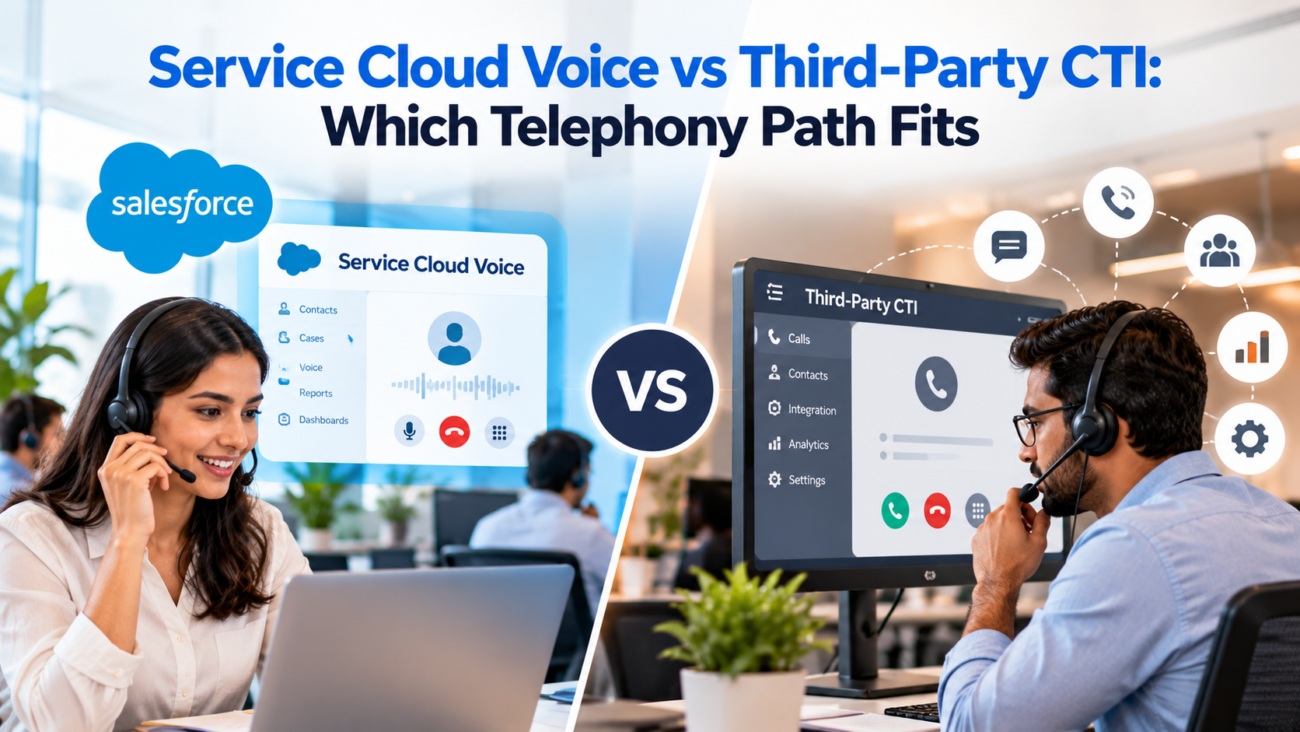
Salesforce teams rarely choose telephony from a blank sheet. Most already have a phone platform, a contact center contract, an IVR design, reporting habits, or years of integration work behind them. The real decision is usually whether to move voice deeper into Salesforce or keep a separate telephony stack connected through a CTI layer. That is why Service Cloud Voice vs third-party CTI is an architecture decision before it is a feature comparison.
Salesforce has renamed parts of its voice portfolio. The former Service Cloud Voice family now appears under Salesforce Voice and Partner Contact Center names, while Agentforce Contact Center covers Salesforce’s built-in voice offer. Older terms still appear in installed environments, so buyers should map them to the current product before comparing options.
A second change makes the comparison more urgent. Salesforce Open CTI, the browser-based framework behind many classic third-party CTI connections, is in maintenance mode and is scheduled to retire on February 28, 2028. Existing phone integrations do not all use the same pattern, and many vendors now support newer partner telephony models. Still, any company considering a long-lived Salesforce CTI integration has to distinguish a modern partner telephony connection from a legacy Open CTI dependency.
Service Cloud Voice vs third-party CTI depends on who should control routing, where call data should live, how deeply voice should participate in Omni-Channel, what supervisors need in Salesforce, and how much change the existing phone platform can tolerate. This guide compares those factors directly so teams can choose a path that fits the contact center they actually run.
TL;DR
Service Cloud Voice vs third-party CTI comes down to integration depth and operating ownership. Salesforce Voice fits teams that want calls represented as Salesforce work with VoiceCall records and Omni-Channel participation. A separate CTI can fit organizations that need to preserve a mature telephony platform, but legacy Open CTI architecture now carries a firm retirement date. Compare the target architecture, provider support, routing model, data location, licensing, and migration effort together.
· Favor the Salesforce Voice model when Salesforce should be the main agent and supervisor workspace.
· Favor a separate CTI model when the existing telephony system must remain the operational center and its Salesforce connector has a supported future path.
· Treat any Open CTI dependency as a migration issue because the framework is scheduled to retire in 2028.
· Price the whole stack, including Salesforce licenses, provider fees, carrier usage, implementation work, and ongoing support.
What The Comparison Actually Means In 2026
The phrase Service Cloud Voice vs third-party CTI can be misleading because Salesforce Voice itself can use third-party telephony. Salesforce’s current voice product names place the former Service Cloud Voice family under Partner Contact Center naming, while Salesforce-owned telephony sits under Agentforce Contact Center. The practical comparison is deeper Salesforce Voice integration versus an independent CTI adapter outside the Voice architecture.
Salesforce Service Cloud Voice was designed to make a phone call a first-class service interaction in Salesforce. In that model, the agent handles the call in the Salesforce workspace, the VoiceCall object represents the call, and Salesforce features can use that record as part of routing, reporting, supervision, and conversation workflows. The underlying carrier or CCaaS system may still be Amazon Connect or another supported telephony provider. Salesforce is the interaction layer even when it is not the network carrying the call.
A third-party CTI model has historically meant that a phone provider embeds or connects a softphone to Salesforce through a CTI framework. The telephony vendor usually owns the call control logic and much of the routing stack. Salesforce supplies CRM context through screen pops, click-to-dial, record searches, activity logging, or vendor-specific APIs. The depth of the Salesforce CTI integration varies widely because one connector may log a basic Task while another may create richer custom records and bring more of the agent workflow into Salesforce.
Salesforce’s telephony model guide now separates built-in voice from partner telephony and Amazon Connect models, which is a better way to frame a new evaluation. The question is no longer simply Salesforce phone versus external phone. It is which platform owns the interaction model and how much of the contact center should be governed inside Salesforce.
That distinction matters for existing systems. A company can keep a preferred CCaaS provider and still move from a legacy softphone pattern into Partner Contact Center Voice if the provider supports it. Another company may stay with a separate Salesforce telephony integration because its dialer, workforce tools, regional carrier contracts, or contact center administration depend on a vendor platform that it does not want to rework.
Service Cloud Voice vs Third-Party CTI At A Glance
The table below summarizes the usual architectural difference. Individual providers can vary, so a vendor capability should be checked against the exact connector and release that will be deployed.
| Decision Area | Salesforce Voice Path | Separate Third-Party CTI Path |
| Agent workspace | Voice is handled inside Salesforce as part of the service workspace | Softphone is embedded in or connected to Salesforce |
| Call record model | Uses Salesforce VoiceCall and related conversation data | Often uses Tasks, custom objects, or vendor records |
| Routing | Can use Salesforce Omni-Channel patterns or mapped provider routing | Usually remains primarily in the telephony platform |
| Supervisor experience | Can use Salesforce voice supervision where provider support exists | Usually relies more heavily on vendor supervisor tools |
| Transcription and AI | Tied more closely to Salesforce voice and conversation features | Depends on the provider and what the connector sends back |
| Telephony choice | Amazon Connect or supported partner telephony models | Broad provider choice, subject to connector support |
| Change ownership | Shared across Salesforce and telephony configuration | Usually centered on the telephony vendor plus integration work |
| Long-term Open CTI risk | Does not depend on legacy Open CTI when built on Salesforce Voice | Must be checked carefully if the connector still depends on Open CTI |
The biggest mistake in Service Cloud Voice vs third-party CTI is comparing only click-to-dial, screen pop, hold, transfer, and wrap-up. Both paths can cover basic call controls. The real difference appears in routing capacity, case context, conversation data, supervisor workflows, recordings, analytics, and future platform changes.
A Salesforce CTI integration can look similar to Salesforce Voice on the agent screen while working very differently underneath. That architecture determines support ownership, reporting behavior, and upgrade work, so those boundaries should be documented before selection.
Agent Experience And CRM Context
Agents feel the telephony architecture through context switching. When Salesforce is the main service desktop, a voice implementation should let an agent accept a call, see the customer record, work the case, complete after-call work, and move to the next item without bouncing between unrelated tools. Salesforce Service Cloud Voice is built around that idea, with the call represented inside the Salesforce interaction model rather than treated only as an external phone event.
The VoiceCall record is important because it gives the interaction a Salesforce identity. A call can be connected with account, contact, case, and conversation information in a way that is easier for Salesforce reporting and automation to use. A third-party CTI can also write rich data into Salesforce, but the design depends on the vendor. Some integrations create Tasks. Others use custom objects or their own managed-package records. The difference affects reporting, permissions, storage, automation, and migration later.
A classic Salesforce telephony integration benefit remains useful: screen pop and click-to-dial. Salesforce’s current Open CTI guide confirms that the browser framework was built to let third-party telephony systems provide softphones without desktop adapters. That made Salesforce Open CTI a common choice for organizations that wanted their established phone system visible inside Lightning without replacing the telephony backend.
The problem is that the agent screen can hide operational separation. An embedded phone may sit inside Salesforce while its state, recordings, queues, agent presence, and interaction history still belong mainly to the provider. This is not automatically a weakness. It can be useful when contact center administrators already work in that provider’s console and need to preserve those controls. It simply means the Salesforce telephony integration is a bridge rather than the primary voice control plane.
For teams that want the Service Console to become the center of daily operations, Salesforce Service Cloud Voice usually provides a cleaner model. For teams whose phone platform is already the center of operations, a separate CTI can reduce disruption. The deciding question is where agents should complete the full service process, not where the call button happens to appear.
Sales and service teams can also need different call patterns. A high-volume outbound team may care more about dialing modes and campaign logic, while service teams may put more weight on queue state and supervisor intervention.
Routing And Omnichannel Control
Routing is one of the clearest architectural differences. Salesforce Voice can connect voice work to Omni-Channel, but the exact routing engine depends on the chosen telephony model. Salesforce explains in its routing model overview that Voice can use unified routing, external routing, or other supported patterns depending on the provider and setup. Teams should decide whether Salesforce or the telephony platform should make the final assignment decision.
Unified routing is attractive when the same agents handle calls and digital work. Salesforce can use a common view of capacity so an agent already busy on a call is less likely to receive another channel assignment that the business does not want. This can also support routing logic that uses Salesforce data. For example, an Omni-Channel flow can evaluate CRM context before directing work to an agent or queue.
Partner telephony introduces an important detail. The telephony system still needs to receive and execute the call-routing instruction. Salesforce documents how unified voice routing works with partner telephony and also lists limitations that admins need to test. This means a Salesforce-centered routing design still depends on provider support and correct user, queue, status, and capacity mapping.
A separate third-party CTI often keeps routing inside the phone or CCaaS platform. That can fit well when years of skill rules, regional queues, IVR flows, and provider features already work there. Rebuilding them in Salesforce can add risk without enough benefit.
When digital channels and voice compete for the same agents, presence must stay aligned. If the provider routes voice while Salesforce routes messaging or cases, both systems can otherwise treat the same agent as available. A Salesforce telephony integration should therefore be tested during transfers, after-call work, browser refreshes, and login changes.
Queue mapping is another point that often gets missed during demos. Salesforce notes in its telephony mapping guidance that Salesforce queues and provider queues must be mapped correctly when the provider is doing the underlying call routing. An unmapped queue can prevent calls from being routed as expected. This is a small configuration detail with direct production impact.
Service Cloud Voice vs third-party CTI should therefore include a routing workshop rather than a feature checkbox. Map inbound calls, callbacks, direct-agent calls, transfers, overflow, after-call work, and outage behavior. Then identify which system owns each step. The right path is the one that produces one dependable assignment model for the business, even if more than one platform participates behind the scenes.
AI, Transcription, And Supervisor Workflows
Voice data is more useful when supervisors and automation can act on it. Salesforce Service Cloud Voice places call data closer to the Salesforce conversation layer, which can make transcription, call context, and supervisor features easier to connect with CRM work. That advantage matters most when the organization intends to use voice information inside Salesforce rather than keep quality management and analytics almost entirely in the telephony platform.
Salesforce Service Cloud Voice supervisor features can include listen-in and barge-in, subject to the telephony model and provider support. Salesforce’s supervisor monitoring guide describes monitoring active calls from Command Center for Service and notes that some features differ based on the telephony provider. This dependency is important. Buying the Salesforce Voice layer does not make every provider feature identical.
Real-time transcription has the same caveat. Salesforce’s Voice limitations state that transcription support can vary by partner telephony provider and language. Some providers may complete transcription only after the conversation has closed. In that case, the transcript may need a different upload path to become available in Salesforce. A buyer comparing Service Cloud Voice vs third-party CTI should ask for the exact behavior of the selected provider rather than assume every Salesforce Voice implementation has the same transcript flow.
A third-party CTI can offer its own speech analytics, summaries, quality scoring, or agent coaching. Those tools may be stronger for a company already standardized on that CCaaS platform. The key question is where the output needs to be consumed. If supervisors live in the provider console and service managers already trust its reports, moving every analytic feature into Salesforce may add duplication. If Salesforce reports and workflows should act on the conversation, deeper Salesforce integration can reduce data movement and custom mapping.
Timing matters too. A transcript or disposition that reaches Salesforce after the call may work for reporting but arrive too late for an immediate follow-up flow. Test the Salesforce CTI integration against the timing required by automations and supervisor alerts.
Integration Architecture And Data Ownership
Architecture decides who can fix the system when something breaks. In a Salesforce Service Cloud Voice model, the integration usually spans Salesforce configuration, the Voice data model, a telephony provider, identity, browser audio, and network access. In a separate CTI model, the integration may include a managed package or custom adapter plus vendor APIs and provider-side services. Both can be reliable, but the support path is different.
Salesforce’s partner telephony setup shows that most partner Voice implementations begin with a telephony provider managed package and then create a Salesforce Voice contact center. That is different from dropping an independent softphone into the utility bar. The managed package supplies metadata that makes the Salesforce telephony integration part of the Voice model, and the resulting contact center is configured as a Salesforce Voice environment.
Data location should be documented before approval. Salesforce conversation information can be split across Salesforce core objects and off-platform conversation storage depending on the channel and feature. Salesforce’s conversation data guidance explains that conversation data for Salesforce Voice with telephony providers is stored in an AWS database rather than only in Salesforce core storage. Teams with retention, residency, legal discovery, or analytics requirements should understand what resides where.
A separate Salesforce CTI integration may keep recordings, transcripts, and detailed call records in the provider while sending selected metadata to Salesforce. That works when the provider is the official voice record system, but teams must know which history still depends on data outside Salesforce.
Ownership also includes configuration. Document where phone numbers, IVR rules, queues, user mappings, and after-call settings are managed, then identify which team can change each layer.
Before a provider change, identify which Salesforce objects and vendor fields have become business dependencies. VoiceCall-based processes may be easier to carry forward than automation tied to package-specific fields.
Reliability, Security, And Compliance
Telephony is a real-time service, so degraded modes matter more than most CRM integrations. A screen pop can fail without ending the call. A browser audio failure is different because the customer may lose contact with the agent. The architecture review should separate call continuity from Salesforce feature continuity and document what agents do if one side is unavailable.
Salesforce publishes Voice limits for concurrent conversations, transcription throughput, call behavior, recordings, and provider-specific features. Those limits are part of capacity planning, especially for large contact centers or organizations that expect sudden demand spikes. A third-party CTI has its own provider limits, API quotas, media requirements, and browser constraints that need the same review.
Salesforce also added formal Voice resiliency guidance in 2026. During a resiliency event, core voice calls can continue while some background capabilities may be limited. This is the right way to assess both paths: list which functions must remain available during a Salesforce problem, a provider problem, a network problem, or an integration problem, then verify each failure mode in design and testing.
Recording rules need similar care. Salesforce lets supported Voice implementations pause and resume recordings when sensitive information is exchanged, and its recording privacy guidance notes that provider configuration affects default recording behavior. The company still owns its legal duties around notice, consent, retention, and access. A feature that can pause recording does not decide when the business is legally required to use it.
Third-party CTI can provide strong compliance controls, but the business must know where they are enforced. If the provider owns consent prompts and recording storage while Salesforce keeps only a call log, the audit evidence will live outside Salesforce.
Cost And Total Ownership
A cost review of Service Cloud Voice vs third-party CTI should include the Salesforce voice layer, the telephony or CCaaS provider, carrier or usage charges, implementation work, recording storage, support, and internal administration. A cheaper per-user license can become expensive when routine routing changes require custom work.
Salesforce currently lists Partner Contact Center pricing at $50 per user per month for the partner telephony integration layer, subject to Salesforce’s stated contract terms and change notices. The same page lists Amazon Connect bundles at $75, $125, and $200 per user per month for 750, 2,000, and 5,000 platform minutes respectively. Those figures are useful reference points, but a buyer should still confirm current regional pricing and what the chosen telephony provider bills separately.
Third-party CTI pricing varies by provider. Some companies already own the contact center platform under a wider agreement, which can make the connector look inexpensive. Include the cost of maintaining the Salesforce CTI integration after Salesforce and provider releases.
Implementation cost depends on how much routing and workflow will move. Keeping the existing phone platform can reduce change if routing remains untouched. Moving into Salesforce Voice may require queue mapping, new presence behavior, Omni-Channel design, recording access, security review, and reporting changes.
For large teams, model 3 years rather than the first invoice. Include license growth, call volume, support, new regions, integration monitoring, and duplicated administration. Service Cloud Voice vs third-party CTI can look different once people and change work are included with license costs.
Price the exit as well. Check recording export, call-history retention, number portability, managed-package data, and automation tied to vendor fields.
Migration Timing And The Open CTI Retirement
Any new comparison has to account for Salesforce Open CTI’s retirement date. Salesforce states that Open CTI retires on February 28, 2028, is already in maintenance mode, and is unavailable for newly created Agentforce Service orgs. That turns a legacy Open CTI connector from a neutral architecture choice into a time-bound dependency.
This does not mean every third-party telephony option must be replaced by Salesforce-owned telephony. It means the connector path needs a supported destination. Many telephony providers can integrate through newer Salesforce Voice partner models, while others may offer another supported Salesforce integration. The vendor should provide a written migration path that identifies the target product, feature gaps, data migration, testing needs, and support dates.
Start by inventorying the current package, Open CTI methods, custom code, screen-pop rules, call objects, SSO behavior, and provider APIs. Separate what can move unchanged from what is tied to the retiring framework.
A phased migration lowers risk. Move a limited user group or queue first, verify routing, recordings, and reporting, then expand. Keep any period of parallel agent presence or duplicate call history as short as possible.
The 2028 date should influence contract timing now. A multiyear renewal for a CTI connector that depends on Salesforce Open CTI should include a clear replacement plan. A new Salesforce telephony integration chosen in 2026 should not create a second migration project before its normal lifecycle would end.
Which Telephony Path Fits Different Operating Models
Salesforce Service Cloud Voice fits best when Salesforce is intended to be the main operating workspace for service agents and supervisors. The value rises when voice should participate in Omni-Channel, call records need to feed Salesforce automation, and supervisors want cross-channel visibility in Salesforce. It also fits teams that are already changing telephony and can redesign routing rather than protect every existing provider rule.
A separate third-party CTI can fit when the telephony platform is strategically important in its own right. The company may use advanced vendor routing, workforce management, outbound dialing, regional carrier features, or quality tools that would be costly to rebuild. In that case, keeping telephony control with the provider and sending the right CRM context into Salesforce can be a sensible design, provided the connector has a supported post-Open CTI future.
A modern partner telephony model can sit between those 2 extremes. The company keeps its CCaaS provider but connects it through Salesforce Voice, giving the contact center a deeper VoiceCall and Omni-Channel relationship than a legacy adapter. The provider can remain while the integration model changes.
Administration ownership matters too. Salesforce Voice can move more control toward Salesforce admins, while a central CCaaS team may prefer to keep routing in the provider across several business units.
Global operations need a country-by-country check for number availability, recording controls, data location, language support, and provider reach. Validate every launch region rather than assuming the first deployment represents the rest.
For Service Cloud Voice vs third-party CTI, the simplest decision rule is to choose the platform that should own the interaction lifecycle. If Salesforce should own work assignment, context, agent state, conversation records, and supervisor workflow, use a Salesforce Voice architecture with a supported telephony model. If the CCaaS platform should continue to own most of that lifecycle, use a supported third-party integration and keep Salesforce focused on CRM context. That distinction is clearer than comparing phone widgets.
Decision Checklist Before You Commit
A buying team can use the following checklist to turn Service Cloud Voice vs third-party CTI into a documented architecture decision rather than a demo preference.
· Confirm the current and target Salesforce voice product names so licensing and roadmap discussions refer to the same offer.
· Identify whether the proposed connector depends on Salesforce Open CTI and what replaces it before February 28, 2028.
· Document which platform owns IVR, queue logic, skills, presence, callbacks, transfers, and after-call work.
· Confirm how voice capacity interacts with messaging and case work in Omni-Channel.
· Identify the Salesforce object that stores each call and where recordings or transcripts reside.
· Test inbound calls, outbound calls, transfers, callbacks, browser refreshes, network loss, and supervisor intervention.
· Verify provider support for transcription, recording controls, routing mode, and supervisor features rather than assuming feature parity.
· Price Salesforce licensing, provider licensing, usage, implementation, recording storage, support, and 3-year administration.
· Check regional number support, recording rules, data location, and language needs for every launch country.
· Define ownership for incidents that cross Salesforce, the telephony provider, identity, browser audio, and the corporate network.
· Build an exit plan covering phone numbers, call records, recordings, custom objects, reports, and automations.
A proof of concept should use real routing and representative calls. A scripted demo rarely exposes the state-sync issues or support boundaries that determine whether a Salesforce telephony integration stays manageable.
Conclusion
Service Cloud Voice vs third-party CTI is best decided by architecture, not by a feature count. Salesforce Voice creates a deeper relationship between phone work and the Salesforce service model. That can help when Omni-Channel, VoiceCall data, Salesforce supervision, and conversation workflows should become part of the same operating environment. A separate CTI can remain the better fit when an existing contact center platform needs to retain control and its Salesforce connection has a clear supported future.
The Open CTI retirement makes one point firm: a new long-term decision should not depend on a framework already scheduled to end in February 2028. Teams that want to keep a preferred telephony provider can still evaluate Partner Contact Center Voice or another supported provider path. The strongest choice is the one that makes routing ownership, data location, support responsibility, cost, and migration timing clear before deployment begins.
FAQs
Is Service Cloud Voice The Same As Salesforce Voice?
Service Cloud Voice is an older product name that still appears in many searches and installed environments. Salesforce now uses names such as Partner Contact Center Voice for telephony-provider integrations and Agentforce Contact Center for its built-in voice offer. Teams should match an older license or implementation to the current product name before comparing features or pricing.
What Is The Main Difference Between Service Cloud Voice And Third-Party CTI?
The main difference is integration depth and operating ownership. Salesforce Voice connects calls more directly with VoiceCall records and Omni-Channel. A separate CTI usually leaves more call control in the telephony provider while sending CRM context into Salesforce.
Can Service Cloud Voice Use A Third-Party Telephony Provider?
Yes. Current Partner Contact Center Voice models are designed to work with supported telephony or CCaaS providers. That is why the comparison should focus on the Salesforce Voice architecture versus a separate CTI adapter model rather than assuming Salesforce Voice always means Salesforce owns the underlying telephony network.
Is Salesforce Open CTI Being Retired?
Yes. Salesforce says Salesforce Open CTI is in maintenance mode and is scheduled to retire on February 28, 2028. Existing organizations that depend on it should identify which managed package, custom code, and softphone behavior relies on the framework and obtain a supported migration plan.
Does Open CTI Retirement Mean We Must Replace Our Phone Provider?
No. A company may be able to keep the same telephony provider and move to a newer supported integration model. The answer depends on the provider’s roadmap. Ask whether the provider supports Partner Contact Center Voice or another Salesforce integration that does not depend on the retiring Open CTI framework.
Which Path Is Better For Omni-Channel Routing?
Salesforce Voice is usually the closer fit when voice and digital work should share Salesforce Omni-Channel capacity and routing logic. Partner support still matters because some routing modes depend on the telephony provider. A separate CTI can work well when routing should remain in the provider platform and presence is synchronized correctly with Salesforce.
Can A Third-Party CTI Still Provide Screen Pops And Click-To-Dial?
Yes. Those have long been core CTI functions. A third-party CTI can provide screen pops, click-to-dial, softphone controls, call logging, and provider-specific features. The deeper question is how much conversation data and routing state the connector shares with Salesforce beyond those basic controls.
Where Do Call Recordings Live With Salesforce Voice?
The answer depends on the telephony model. Recording access can involve Salesforce and provider permissions, while conversation data may use Salesforce off-platform storage. Document the recording location, retention rule, access model, and export method before launch.
Does Salesforce Voice Include Real-Time Transcription For Every Provider?
No. Salesforce notes that real-time transcription support varies by telephony provider and language. Some providers may complete transcription after the call has ended. Buyers should validate the selected provider’s behavior and confirm when the transcript becomes available for Salesforce workflows or reporting.
Is A Third-Party CTI Usually Cheaper?
Not always. A connector may have a lower visible license price, especially when the company already owns the phone platform, but total cost includes provider fees, carrier usage, implementation, support, upgrade work, and internal administration. Compare 3-year operating cost rather than the first per-user price.
What Should We Test In A Telephony Proof Of Concept?
Test real inbound and outbound flows, transfer behavior, callbacks, after-call work, recording controls, agent status changes, browser refreshes, network interruptions, supervisor actions, reporting, and failure recovery. Also test how voice work competes with digital work when the same agents use multiple channels.
Can We Keep Routing In Our Existing CCaaS Platform?
Yes. External routing remains a valid pattern for supported Salesforce Voice models, and a separate CTI often keeps routing in the provider by design. The important requirement is clear ownership of queues and agent state plus reliable synchronization where Salesforce needs current availability information.
Which Option Is Easier To Maintain?
Maintenance depends on the current architecture and team skills. Salesforce Voice can reduce custom integration code when the business adopts supported Voice patterns. A separate CTI can be simpler when the existing provider already owns the full contact center and Salesforce needs only a limited CRM connection. Unsupported custom code makes either path harder.
How Does Salesforce CTI Integration Affect Reporting?
Reporting depends on the record model. Salesforce Voice uses VoiceCall and conversation-related data that Salesforce tools can reference. A third-party CTI may use Tasks, custom objects, or managed-package records. Before selection, confirm which fields are available in Salesforce and how supervisors will report across calls and digital work.
When Should We Choose Partner Contact Center Voice Instead Of A Legacy CTI?
Partner Contact Center Voice is worth serious consideration when the company wants to keep a supported telephony provider while moving voice deeper into Salesforce. It is especially relevant when the current connector depends on Salesforce Open CTI, because the 2028 retirement creates a fixed deadline for that legacy integration path.
