
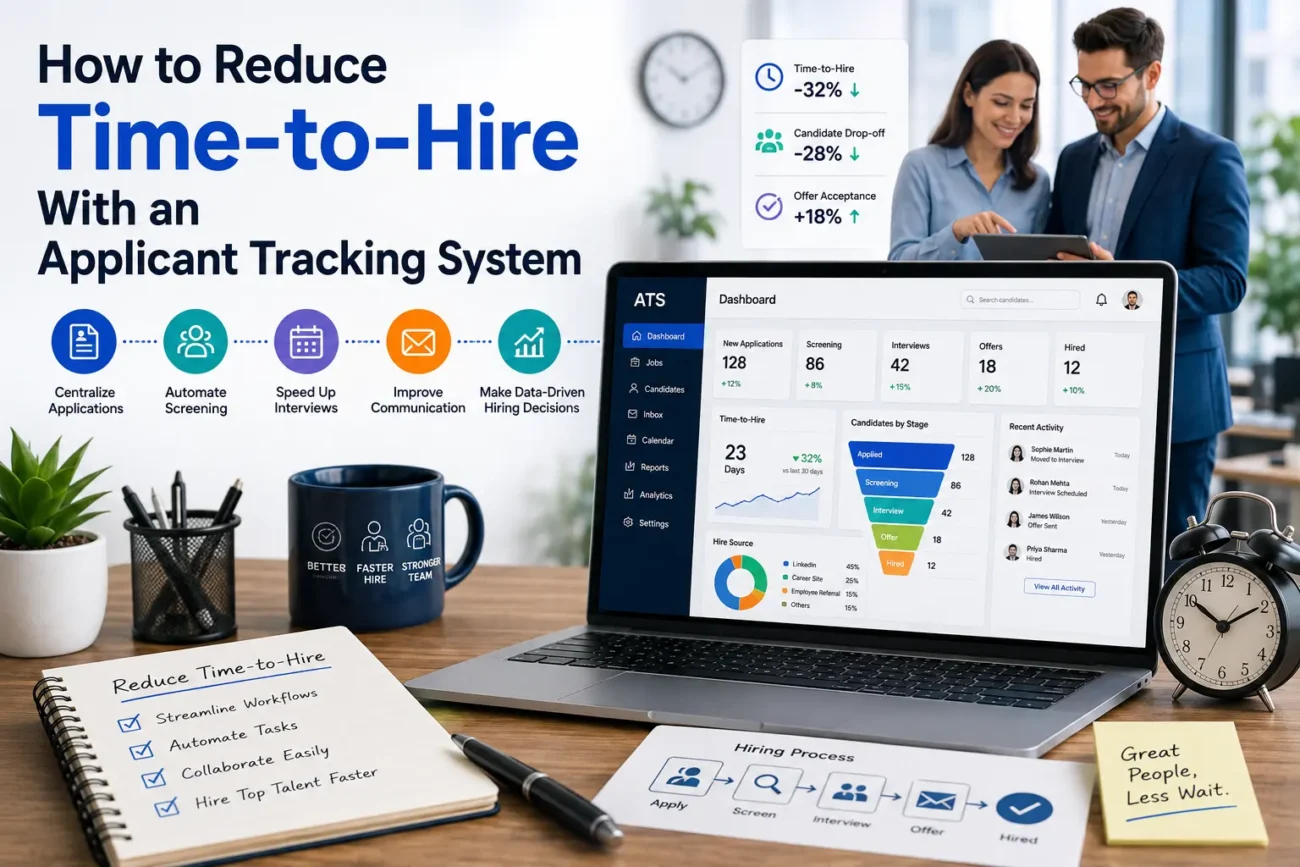
Hiring delays usually build between decisions.
A recruiter receives a promising application on Monday but reviews it on Wednesday. The hiring manager responds on Friday. Scheduling pushes the first interview into the following week. Feedback takes another 2 days, then the offer waits for approval while the candidate continues interviewing with other employers.
Each delay looks manageable when viewed alone. Added together, they can turn a reasonable hiring process into a long candidate journey. The problem gets harder when recruiters are handling larger applicant volumes while hiring managers still have the same number of hours available for reviews, interviews, feedback, and final decisions.
Current hiring benchmarks show the scale of the issue. SmartRecruiters reports a global median time-to-hire of 38 days in its 2025 to 2026 benchmark. Candidates in that dataset were reviewed in about 6 days, reached interviews around day 14, and completed the full hiring process in nearly 6 weeks.
Application volume has also risen sharply. Greenhouse reports that applications per job increased from 116 in 2022 to 244 in 2025 across more than 6,000 companies. Annual applications handled per recruiter rose from 146 to 746 during the same period, while the average number of recruiters per organization fell.
An applicant tracking system can reduce time-to-hire by controlling what happens between those hiring events. It can keep applications in visible queues, assign responsibility, coordinate interviews, collect feedback, route approvals, send routine candidate updates, and show where candidates have stopped moving.
The useful question is simple: where are qualified candidates waiting for an internal action?
Find those waits first. Then configure the applicant tracking system around the response.
TL;DR
An applicant tracking system can reduce time-to-hire by cutting avoidable waiting across application review, hiring-manager review, scheduling, interviews, feedback, final decisions, and offer approvals. The largest gains usually come from shortening the gaps between recruiting activities rather than trying to make individual interviews or recruiter calls a few minutes shorter.
Ashby’s 2026 recruiting operations research supports that view. Its analysis covers more than 54 million applications and 93,000 jobs from January 2021 through March 2026. The research found that time-to-hire is shaped by smaller delays across several stages of the hiring process.
Start by measuring how long candidates remain in each stage. Give every active candidate a clear owner and next action. Use ATS automation for predictable administrative work. Set interview criteria before interviews begin, track missing feedback, and keep offer approvals visible from decision through delivery.
External benchmarks help you understand the market, but your ATS contains the more useful answer. Find the stage where candidates repeatedly wait longer than expected. Fix that stage, measure the result, then move to the next constraint.
1. Measure where time-to-hire is actually being lost
A single time-to-hire figure tells you what happened after the process is finished. It gives you limited help while candidates are still moving through the pipeline. A 41-day average could come from slow application review, limited interviewer availability, delayed feedback, or an offer approval queue.
Stage timing makes the metric useful. Record when candidates enter and leave every meaningful hiring stage, then calculate how long they spend waiting for the next action. Review both the normal candidate journey and the unusually old records that sit far beyond your usual range.
Keep time-to-hire separate from time-to-fill. SHRM reports a 2026 median time-to-fill of 39 calendar days for nonexecutive positions. SmartRecruiters reports a 38-day global median time-to-hire using a different dataset and measurement. Treating those figures as interchangeable can distort internal comparisons.
Your ATS reporting should therefore define every timing metric before leadership starts comparing numbers. Once the definitions are fixed, the recruiting team can trace overall hiring speed back to the stage creating the delay.
| Metric | Start point | End point | What it helps identify |
| Time-to-fill | Requisition opened | Offer accepted | Total vacancy duration |
| Time-to-hire | Candidate enters process | Offer accepted | Candidate movement through hiring |
| Time to first review | Application received | Initial review | Applicant queue delay |
| Manager review time | Candidate sent to manager | Manager response | Internal handoff delay |
| Scheduling time | Interview requested | Interview booked | Coordination delay |
| Interview lead time | Interview booked | Interview held | Interviewer capacity |
| Feedback turnaround | Interview completed | Feedback submitted | Interviewer response delay |
| Decision time | Final interview completed | Decision recorded | Decision-making delay |
| Offer turnaround | Hiring decision | Offer sent | Approval and document delay |
Use median stage time alongside averages where your reporting allows it. A small number of very old candidates can push an average upward and make a normal stage look slower than most candidates experience.
Then review the old records separately. A 2-day median manager review can still hide 8 candidates who have been waiting for more than a week. Those candidates require an operational response now, rather than another monthly dashboard later.
2. Control candidate queues before adding more automation
Most hiring delays are queue times. Applications wait for recruiters, reviewed candidates wait for managers, interview-ready candidates wait for calendar space, and completed interviews wait for feedback. Ashby’s research found that several of these smaller delays contribute to total time-to-hire.
An ATS should make those queues visible without requiring a recruiter to compare spreadsheets, search email, or ask for updates in chat. Every active candidate needs a current stage, a responsible owner, a next action, and enough timing information to show how long that action has been waiting.
A pipeline containing 120 candidates in an “interview” stage tells a recruiting leader very little. A view showing 7 candidates who have waited more than 4 business days for scheduling gives the team something specific to fix.
Candidate ownership should move with the workflow. A recruiter may own initial review, a hiring manager may own the next decision, a coordinator may own interview scheduling, and the recruiter may own candidate communication again after the interview.
The ATS needs to make those handoffs clear.
A practical aging review should check:
- Current hiring stage.
- Date the candidate entered that stage.
- Person responsible for the next action.
- Expected next action.
- Internal response target.
- Date of the last candidate update.
- Reason for any approved pause.
- Whether the candidate is still actively under consideration.
Review the oldest candidates first.
If the same person or department appears repeatedly, you have found a process issue rather than an isolated late response. If the same stage is slow across several departments, inspect the workflow itself.
The goal is to catch delay while it can still be corrected. By the time a 50-day hire reaches a monthly report, every opportunity to shorten that candidate’s journey has already passed.
3. Fix requisition intake before applications arrive
Hiring delays can begin before the job is posted. A recruiter starts with an unclear brief, the hiring manager changes the profile after seeing applicants, another stakeholder introduces a requirement during interviews, and the final candidate goes through an extra meeting because the original decision process wasn’t agreed.
Use the ATS requisition process to settle those questions earlier. The hiring team should define what success requires, which requirements can flex, how candidates will be assessed, who owns each decision, and how the offer gets approved before the application volume arrives.
A useful intake process can follow 6 steps.
- Define the reason for the opening. Explain the business need behind the position and what the person will be expected to accomplish. This gives the recruiter a clearer hiring target than a copied job description or a list of familiar credentials.
- Separate requirements from preferences. Identify the experience or capability that genuinely affects job performance. Keep preferred background separate so recruiters don’t treat every familiar profile characteristic as a condition for entering the process.
- Confirm the compensation boundary. Record the approved range and decide who reviews an exception. This reduces late internal negotiation after the hiring team has already selected a candidate.
- Design the interview path. Decide which stages are required and what evidence each stage needs to collect. Every additional interview should exist because it answers a hiring question that earlier stages haven’t answered.
- Assign decision ownership. Identify the hiring manager, interview participants, requisition approvers, offer approvers, and backup owners. The ATS can route work properly when those responsibilities are known before candidate activity begins.
- Confirm actual hiring capacity. Check whether reviewers and interviewers have time available during the planned hiring period. A role labeled urgent will still move slowly when calendars contain no room for candidate work.
Greenhouse’s current structured hiring guidance also starts with alignment around role goals, hiring criteria, scorecards, and the interview plan before interviews begin.
Use ATS job templates for recurring positions where the underlying process is genuinely similar. Keep role-specific decisions open where the job differs. A template should remove repeated setup work while preserving the judgment needed for the current opening.
4. Reduce application review time without weakening screening
Application review becomes harder as inbound volume increases. Greenhouse reports 244 applications per job in 2025 across its benchmark dataset, compared with 116 in 2022. Annual applications handled per recruiter rose 412% during the same period.
That increase creates a simple operational risk. A qualified applicant can spend several days inside a large queue before anybody sees the application. By the time the recruiter responds, the candidate may already be moving through another employer’s interview process.
ATS screening should reduce the effort required to find relevant candidates while keeping the criteria connected to the work. Start by separating eligibility from preference, then configure the application process around the smallest amount of information needed for the first decision.
Useful review controls include:
- Required screening questions connected to job requirements.
- Saved views for new applications awaiting review.
- Separate queues for employee referrals where appropriate.
- Filters based on relevant candidate information.
- Duplicate candidate identification.
- Clear disposition reasons for closed applications.
- Views for applications that require manual review.
- Searchable records of previous qualified candidates.
Keep knockout questions narrow. A question should exist because the answer can legitimately determine whether someone can continue in the process. Broad questions produce inconsistent interpretation and may reject people for criteria that aren’t essential to the work.
Automated rejection deserves more review than administrative sorting. The EEOC has warned that algorithmic and AI-based employment tools can screen out qualified people with disabilities, and its guidance says employers should have processes for reasonable accommodation where required.
The ATS should help recruiters work through volume faster. The hiring standard still needs job-related criteria, clear ownership, and appropriate review when software affects who gets the opportunity to continue.
5. Remove interview scheduling as a recurring delay
Interview scheduling is a good place to remove administrative waiting because the steps are predictable. Manual coordination creates repeated email, calendar checking, rescheduling, and reminder work before anybody begins assessing the candidate.
Ashby’s 2026 research found that interviews using automated scheduling were confirmed 26% faster than interviews scheduled manually. Its reported median confirmation time was 3.7 hours for automated scheduling compared with 5 hours for manual scheduling.
Scheduling speed still depends on available interview capacity. An ATS can find open calendar slots, but it can’t create calendar space when every qualified interviewer is booked for the next 9 days.
Separate the scheduling problem from the capacity problem.
| Scheduling issue | ATS response | Hiring-team response |
| Repeated availability emails | Candidate scheduling options | Decide which stages allow self-scheduling |
| Recruiter checks calendars manually | Connected calendar availability | Keep calendars current |
| Candidate needs another time | Controlled rescheduling path | Define rescheduling rules |
| Panel member becomes unavailable | Alternative interviewer options | Maintain qualified interviewer pools |
| Interview is booked far ahead | Lead-time reporting | Reserve more interview capacity |
| Recruiter sends reminders manually | Scheduled reminders | Approve timing and message content |
| Candidate receives unclear instructions | Interview communication template | Define required meeting information |
Track stage entry to schedule sent separately from schedule sent to interview held.
A long first interval usually points toward coordination. A long second interval often points toward limited interviewer availability. Combining them into 1 scheduling number makes it harder to choose the correct response.
For priority hiring, reserve interview time before the pipeline fills. A hiring manager who considers a role urgent should have calendar space that reflects the same priority.
6. Use structured interviews to reduce decision delay
Scheduling gets candidates into interviews. Interview design determines whether those meetings produce enough evidence for a timely decision.
Unstructured interviews often create rework because different interviewers assess different things. One person focuses on career history, another discusses the job in general terms, and another repeats questions already asked earlier. The debrief then becomes an attempt to reconstruct what the team actually learned.
Greenhouse describes structured hiring as a process where success is defined before the search, candidates are assessed against shared criteria, and decisions are based on recorded evidence. Its current guidance places role definition, scorecards, interview planning, and interview kits before the final selection discussion.
Define the purpose of each stage
Every interview should answer a known hiring question. Decide what evidence the stage needs to collect and assign responsibility to the interviewer before the candidate arrives.
A stage without a distinct purpose deserves review. Repeating a previous conversation consumes interviewer capacity and adds another scheduling dependency without giving the hiring team much new information.
Use focused scorecards
A scorecard should tell interviewers what they need to assess and give them a place to record evidence. Greenhouse describes interview scorecards as a framework that guides interviewer evaluation and feedback against the requirements of the role.
Keep the scorecard focused enough that interviewers will complete it. A short record of useful evidence gives the decision team more value than a long form filled with rushed ratings.
Reduce question duplication
Map interview questions to the evidence each stage owns. If several interviewers ask about the same part of the candidate’s background, redesign the loop so later meetings collect information that hasn’t already been covered.
This shortens the candidate journey and reduces interviewer hours. It also gives the final discussion a wider evidence base.
Collect feedback while evidence is fresh
The ATS should attach the correct scorecard to the interview and show which required feedback remains unfinished. Ask interviewers to record observations soon after the meeting while the conversation is still easy to recall.
The final decision then starts from written evidence rather than memory. That can reduce the amount of time spent reopening questions that should have been answered during the interview itself.
7. Treat feedback, decisions, and offers as separate hiring stages
A candidate can finish the final interview and still spend several days waiting for the company to act. Feedback may be incomplete, the hiring manager may need another discussion, compensation may require approval, and the offer document may sit with another team.
Ashby’s analysis identifies feedback, decision-making, and offer approvals as recurring sources of hiring delay. Its benchmark also found some of the larger differences between faster and slower organizations in offer turnaround.
Keep the post-interview process visible with a defined sequence.
- Request required feedback immediately after the interview. The ATS should know which scorecards need completion and who owns each one.
- Surface overdue feedback. Missing interview evidence should appear in an active queue rather than depending on recruiter memory.
- Hold decision time early. For final-stage candidates, reserve a decision slot before the last interview where the hiring process supports it.
- Record the official decision in the ATS. Keep the candidate stage aligned with what the hiring team has actually decided.
- Start offer approval from the recorded decision. The approval route should already be known from requisition intake.
- Route exceptions to the right owner. Compensation or employment terms outside approved boundaries may need a separate path.
Measure final interview to decision separately from decision to offer sent.
A long decision interval may point toward missing evidence or stakeholder availability. A long offer interval may point toward compensation authority, document preparation, or approval routing.
The candidate experiences both as waiting. Your ATS needs to show which internal process created it. Once the offer is accepted, the same clean handoff should continue into the new-hire onboarding workflow.
8. Keep candidate communication connected to real stage changes
Candidate communication affects how hiring time is experienced. A company may need several days to complete a legitimate decision, but uncertainty grows quickly when the candidate doesn’t know what happens next or when another update will arrive.
ATS communication works well when a real workflow event triggers it. The application has been received. An interview needs booking. A confirmed meeting has changed. The hiring team needs another piece of information. A decision has been recorded.
Each message should tell the candidate what happened and what action is required, if any. It should also set an expectation for the next step where the recruiting team can reasonably provide one.
Data accuracy matters here. An automated message triggered from the wrong candidate stage can create more confusion than a manual process. Recruiters need to keep the ATS status aligned with the actual hiring decision.
Test the candidate experience from the candidate side rather than relying only on the recruiter interface.
Review these areas:
- Application completion on a phone.
- Resume or document upload.
- Screening-question clarity.
- Interview scheduling flow.
- Rescheduling process.
- Interview instructions.
- Candidate help contact.
- Accommodation request path.
Communication becomes especially important when the company misses its own expected timing. If a candidate was told to expect a final answer on Friday and the decision has moved to Tuesday, the recruiter should update the candidate before the candidate has to ask.
The ATS can surface the overdue action. The recruiter still owns the relationship and the judgment about what the candidate needs to know.
9. Reuse qualified candidates already stored in the ATS
Recruiting teams often treat every new opening as a new search. The applicant tracking system may already contain people who reached final interviews or fit future openings, including candidates who withdrew because of timing, lost to another strong candidate, or applied before the right opening existed.
Reusing that history can shorten the time required to produce a relevant shortlist. The value depends on the quality of the candidate records saved during previous hiring cycles.
Generic disposition reasons weaken future search. A record marked only “rejected” tells another recruiter little about whether the person may fit a different role later.
Use disposition reasons that explain the hiring outcome without adding unnecessary or inappropriate commentary.
Useful review areas include:
- Candidates who reached later interview stages.
- Previous applicants marked for future consideration.
- People who withdrew because of timing.
- Former interns or employees where rehiring is appropriate.
- Candidates who lacked 1 role-specific requirement.
- Previous applicants whose location now fits the opening.
- Strong referrals from earlier hiring cycles.
- Candidates considered for similar job families.
Keep records accurate and follow the retention rules that apply to your organization. Candidate rediscovery depends on people being able to trust the information they find.
A good talent pool should also have a reason to exist. Avoid turning it into a large archive that recruiters never use. Group candidates around recurring hiring needs where the team expects to search the group again.
The ATS becomes more useful over time when previous hiring work remains searchable. A recruiter who can start with an existing pool may reach qualified candidates before a new job posting has produced enough inbound volume.
10. Match recruiting automation to the level of decision risk
ATS automation can remove repeated administration. The level of control should increase as the automated action gets closer to deciding whether someone receives an employment opportunity.
An interview reminder has a limited effect on candidate selection. A tool that ranks applicants or automatically rejects them has a much larger effect. Treating both types of automation the same creates unnecessary risk.
Use a risk-to-response model when deciding what to automate.
| ATS actionDecision | Impact Practical | response |
| Application confirmation | Low | Automate after reviewing content |
| Interview reminder | Low | Trigger from confirmed scheduling data |
| Candidate self-scheduling | Low | Automate with an exception path |
| Feedback reminder | Low | Trigger against assigned ownership |
| Stage-aging alert | Low | Automate against internal timing rules |
| Requisition approval | Moderate | Use documented decision rights |
| Candidate ranking | Higher | Validate criteria and review results |
| Automatic rejection | Higher | Review job relevance, access, and applicable law |
| AI assessment affecting advancement | Higher | Apply testing, audit records, and human review |
Employers remain responsible for employment practices when software takes part in hiring. Algorithmic bias in hiring deserves specific review because AI tools can affect who advances through the process.
Local requirements may add another layer. New York City’s Local Law 144 restricts the use of covered automated employment decision tools unless requirements concerning a recent bias audit, public information, and candidate or employee notices have been met.
Before enabling a higher-impact feature, document what information it uses, what output it produces, and how that output affects the candidate. Record who can review or override the result and how unusual cases are handled.
Administrative automation should reduce repeated work. Selection technology needs stronger controls because its consequences reach further into the hiring decision.
11. Implement the ATS around the process you want to run
A new ATS can preserve every old hiring problem if the implementation simply copies the previous workflow.
The better starting point is the current process itself. Measure where candidates wait, identify work happening outside the system, review stages that no longer add useful evidence, then build the future workflow around the decisions the hiring team actually needs.
The implementation can follow 6 phases.
- Assess. Pull recent hiring records and calculate stage timing. Document spreadsheets, manual reminders, calendar workarounds, side tools, and approval emails used to keep candidates moving.
- Decide. Define the candidate stages, owners, interview evidence, approval paths, reporting definitions, and role groups that genuinely require different hiring workflows.
- Configure. Build the agreed process inside the ATS. Set permissions, connect calendars, create scorecards, add appropriate reminders, and configure approved candidate communication.
- Test. Run normal hiring cases alongside candidate withdrawal, rescheduling, duplicate applications, missing feedback, compensation exceptions, failed integrations, and accommodation requests.
- Pilot. Use a controlled group of live requisitions. Watch where recruiters leave the system, which notifications managers ignore, and where candidate status stops matching reality.
- Review. Compare stage timing with the original baseline. Fix the next repeated delay, update the configuration where needed, and keep measuring the same stages.
This approach follows the same implementation logic used in the reference article: assess the existing environment, decide what deserves to remain, prepare the new process, test it on a smaller surface, then expand after the workflow has been proven.
A successful ATS launch should change how hiring work moves. Replacing the interface while preserving the same queues gives the recruiting team a new system with the old wait times.
12. Build an ATS dashboard around active hiring constraints
Overall time-to-hire remains useful for leadership reporting. Recruiters and hiring managers also need measures that show what requires attention today.
Stage-age reporting should sit near the center of that dashboard. It identifies candidates who are still active but have remained in the same stage beyond the normal range.
Combine timing with conversion. Speed alone can create misleading conclusions if candidates are being moved quickly through poorly designed stages or if an early screening stage advances too many people into expensive interviews.
| Metric | What a high figure may indicate | First place to inspect |
| Time to first review | Application backlog | Review ownership and recruiter capacity |
| Manager review time | Internal handoff delay | Manager queue and response expectation |
| Scheduling time | Coordination problem | Scheduling workflow |
| Interview lead time | Limited capacity | Interviewer availability |
| Feedback turnaround | Incomplete interview process | Scorecard ownership |
| Final decision time | Decision delay | Evidence quality and stakeholder access |
| Offer turnaround | Approval delay | Compensation and offer workflow |
| Time in stage | Candidate stagnation | Stage owner and next action |
| Candidate withdrawal | Pipeline loss | Withdrawal stage and stated reason |
| Offer acceptance | Late-stage conversion issue | Expectations, role conditions, and process |
Compare similar role groups where possible. Ashby’s 2026 analysis found different interview and hiring patterns between technical and business roles, which is one reason a single company-wide target can hide useful variation.
Review the distribution as well as the median. A healthy median can sit beside a small group of candidates who have been forgotten for much longer than the normal process.
The dashboard should help the team find those candidates while something can still be done. Recruiting reporting becomes more useful when it directs the next action instead of simply describing the previous month.
13. Use a 90-day plan to reduce time-to-hire with your current ATS
A company can begin reducing hiring delays before replacing its applicant tracking system. Start with the technology already in place and test how much of the problem comes from workflow design, configuration, adoption, or an actual system limit.
Use a 90-day improvement cycle.
Days 1 to 15: establish the baseline
Pull recent hires and calculate time in each stage. Review active candidate aging, identify outdated records, map manual scheduling work, inspect missing feedback, and document the current offer approval route.
Choose the repeated delays that create the most candidate waiting time. Keep the scope small enough that the team can see whether a process change actually affects the numbers.
Days 16 to 30: fix ownership
Assign an owner to every problem stage. Set internal response expectations, clean inaccurate candidate statuses, clarify approval responsibility, and make aging candidates visible to recruiters and hiring managers.
Use existing ATS views or reports before building new technology. Better ownership may remove part of the delay without another software purchase.
Days 31 to 60: configure the response
Enable suitable scheduling functions, feedback reminders, candidate communication, approval routing, and other available ATS features that address the delays found during the baseline.
Test the workflows before expanding them. A reminder sent to the wrong person or an incorrect stage-triggered email can create another source of administration.
Days 61 to 90: measure the change
Compare the targeted stage times with the original baseline. Check candidate withdrawal, offer turnaround, and recruiter workload where the information is available.
If the first constraint improves, identify the next repeated delay. If nothing changed, inspect whether the problem comes from adoption, limited system capability, or a process decision outside the ATS.
This cycle gives leadership stronger evidence for future ATS spending. The company can distinguish between problems a configuration change can fix and limitations that genuinely require different software.
The bottom line
An applicant tracking system can reduce time-to-hire when it shortens the periods where candidates are waiting for internal action.
Application review needs an owned queue. Hiring-manager reviews need visible timing. Interview scheduling needs available calendar capacity. Interviews need clear evaluation criteria. Feedback needs assigned responsibility. Offers need a defined approval path.
Current recruiting research points toward the same operating problem. SmartRecruiters reports a 38-day global median time-to-hire. Greenhouse reports much higher application volume per role than several years ago. Ashby’s research finds that total hiring time builds from smaller delays across several candidate stages.
Start with your own ATS.
Find the longest repeated period where a qualified candidate is waiting for someone inside the company. Identify who owns the next action. Decide whether the ATS can remove the administrative delay or simply needs to make the overdue work easier to see.
Fix that stage and measure it again.
Then move to the next constraint.
That is how an applicant tracking system reduces time-to-hire while keeping the hiring decision tied to evidence.
Frequently asked questions
1. How does an applicant tracking system reduce time-to-hire?
An applicant tracking system can reduce time-to-hire by making candidate movement easier to manage across application review, scheduling, interviews, feedback, decisions, approvals, and offers. It gives recruiters a central view of candidate status and the work waiting for action.
Start by measuring stage timing. Configure ATS workflows around the stages creating repeated delay rather than turning on automation without a defined operating problem.
2. What is a good time-to-hire?
There isn’t 1 target that fits every employer or job. SmartRecruiters reports a 38-day global median time-to-hire in its 2025 to 2026 benchmark, while hiring patterns vary by location, role, company size, and selection process.
Use external benchmarks for context. Your stronger comparison is usually between similar roles inside your company and the way their stage timing changes over several hiring cycles.
3. What is the difference between time-to-hire and time-to-fill?
Time-to-fill generally measures the period from an opened requisition to an accepted offer. Time-to-hire focuses more closely on how long a candidate takes to move through the hiring process after entering the relevant measurement period.
Definitions vary between employers and research providers. Record the exact formulas used in your ATS so recruiters and leadership don’t compare figures calculated from different starting points.
4. Which ATS feature can reduce hiring time fastest?
Interview scheduling can produce an early improvement where manual calendar coordination is creating repeated delay. Ashby’s 2026 research found that automated scheduling confirmed interviews 26% faster than manual scheduling in its dataset.
Check your own data before choosing the first feature. An employer with a 6-day manager-review queue may gain more from fixing that handoff than changing interview scheduling.
5. Can an ATS automate candidate screening?
Many applicant tracking systems can support screening questions, search, filters, candidate ranking, or AI-assisted application review. These features may reduce recruiter workload where large application volumes make manual triage difficult.
Higher-impact screening requires additional controls. Review whether criteria relate to the job, how accommodations are handled, what applicable employment rules require, and where human review belongs in the process.
6. How can an ATS reduce interview scheduling delays?
An ATS can connect calendars, offer available interview times, support candidate self-scheduling, manage rescheduling, issue invitations, and send reminders. These functions reduce the amount of manual coordination required from recruiters.
Measure scheduling time separately from interview lead time. A meeting that is booked quickly but scheduled 9 days later usually points toward interviewer capacity rather than a scheduling-system problem.
7. How can an ATS improve hiring-manager response time?
The system can assign candidate reviews, show how long each review has been waiting, send reminders, and display overdue work in recruiter or manager views. This makes the handoff easier to see and measure.
The company still needs a clear response expectation. Software can identify a late review, while hiring leadership needs to address repeated delays when the same queue remains slow.
8. Which ATS metrics should recruiting teams monitor?
Useful measures include time to first review, manager review time, scheduling time, interview lead time, feedback turnaround, final decision time, offer turnaround, candidate withdrawal, offer acceptance, and time in stage.
Review these measures by relevant role groups where possible. Pair speed with conversion and candidate outcomes so the team doesn’t improve a timing number by weakening the hiring process.
9. What should employers check before using AI inside an ATS?
Employers should understand what candidate information the feature uses, what output it produces, how that output affects advancement, who can review the result, and how exceptions or accommodation requests are handled.
Applicable rules depend on the tool and location. EEOC guidance addresses disability discrimination risks from AI hiring tools, while New York City has separate requirements for covered automated employment decision tools.
10. What should a company do before replacing its ATS?
Measure the current hiring process first. Pull recent hires, calculate stage timing, inspect active candidate aging, and document recruiting work happening in spreadsheets, email, calendars, chat, or other systems.
That assessment helps separate process design problems from configuration gaps and real software limitations. The replacement decision can then be based on hiring work the current system can’t support.
