
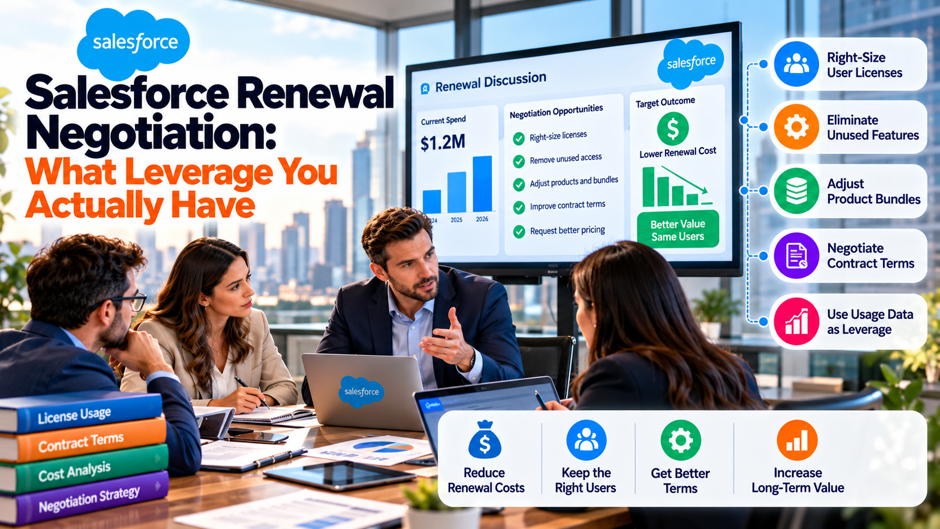
Picture an illustrative company that spends $600,000 a year on Salesforce. The renewal quote lands about 6 weeks before the term ends, the number is higher than last year’s and the account executive mentions that the quarter closes soon. The finance lead asks what the company can realistically push back on. Some vendor-side playbooks promise 30 percent savings, while the account team says the pricing is standard. The honest answer sits between those positions, and it depends on facts you can gather before the quote arrives.
This article sorts the levers that tend to move a Salesforce renewal from the ones that sound good and rarely do. It draws on a buyer-side advisory firm’s renewal paper, a procurement-software vendor’s playbook, a late-quote guide and arithmetic done in code. Both sources sell services or software and publish mostly unsourced figures, so every percentage is attributed and treated as directional. Check your own order forms and master agreement, and confirm contract and pricing terms with Salesforce and counsel.
TL;DR
- Your strongest lever is a smaller, better-documented footprint. Redress Compliance, a buyer-side advisory firm that sells services, says a login and feature audit is the base of every other argument. Its savings claims are unsourced, so run your own numbers before you quote anyone’s percentage to your account executive.
- Timing and written alternatives carry weight, but less than vendors claim. Tropic, a procurement-software vendor, reports that competitive quotes have limited effect on products under 9 months from renewal. Start 9 to 12 months out, hold a written alternative for a specific product line and treat the quarter-end as a possible, unconfirmed advantage.
- Price is only a single term. Ask for a cap on annual increases, a right to reduce quantity, swap rights and clear line-item pricing. In an illustrative $600,000 example, a 15 percent smaller footprint and a 3 percent cap produce a $525,300 renewal, against a $660,000 opening quote, a $134,700 difference.
What bargaining power means in a Salesforce renewal
Your pull is mostly information. The most useful thing you can bring to a renewal is accurate knowledge of what your company uses, what it pays per seat and what it could do without. Salesforce’s account team knows its own discount authority, its quarter targets and what similar customers accepted. You can narrow that gap with usage data, a clean inventory of licenses and a clear internal view of which products are essential and which are habit.
Salesforce’s pull is the calendar and the switching cost. A CRM holds years of data, integrations and trained users. Everyone in the negotiation knows that moving off it takes many months and a lot of money, so a vague threat to leave carries little weight. Buyers who start late also hand Salesforce a deadline it doesn’t have to share, because the old contract ends and the options narrow with each passing week.
Your pull depends on credible alternatives for specific products. The threat that works is narrow and documented. Tropic’s playbook advises focusing competitive pressure on specific products rather than the whole CRM or marketing stack, and Redress says a written Microsoft Dynamics 365 proposal at your actual user count changes the conversation. A written proposal for 1 product line costs far less to produce than a migration plan and it gives your side something concrete to point at.
Every source here needs a discount. Redress and Tropic both sell something, and their figures come from their own client data, which neither publishes. Use them to learn which questions to ask, then test every number against your quote, your contract and your own market inquiries. A percentage that worked for another customer in a different year says little about your outcome. Ask where each number came from before it shapes a decision.
Levers ranked by strength
Strength varies by lever, by company size and by how much time remains. The table ranks the common ones by how reliably they move a renewal, based on the sources reviewed and my own judgment, which makes it a judgment rather than a measured result. Treat the order as a starting point for discussion with your finance and procurement colleagues, and adjust it once you’ve seen how your account team responds to the first proposal.
| Lever | Typical strength | Why it works or doesn’t | Main risk |
| Right-sized license count | Strong | Reduces the base before any discount is applied | Cutting seats that users still need |
| Starting 9 to 12 months out | Strong | Leaves time for several rounds and a plan B | Internal teams that won’t engage early |
| Cap on annual increase | Moderate to strong | Limits future cost as well as this year’s | Salesforce may trade it for a longer term |
| Written competitor proposal for a product | Moderate | Gives the buyer a documented option | Switching costs weaken the threat on core CRM |
| Quarter-end or fiscal year end timing | Uncertain | Sales teams may have more discount authority | Rushed decisions and weak preparation |
| Multi-year commitment | Moderate | Salesforce values the longer commitment | Loss of flexibility if needs change |
| Executive escalation | Situational | Aligns senior sponsors on both sides | Wasted if the ask isn’t specific |
Why the calendar matters more than the pitch
A strong argument delivered late tends to lose to an average argument delivered on time. Redress describes starting 60 to 90 days out as a trap and recommends beginning 9 to 12 months before expiry, with an audit first, competitive proposals next, internal alignment after that and negotiations in the last 4 months. Even if you shorten that schedule, the principle holds: each step needs weeks, and the steps depend on each other.
The early start does more than create time. It lets you collect data without pressure, ask hard questions of your own teams and decide in advance what you’d accept. Redress also advises setting your walk-away position internally before talks begin, so the account team can’t find your acceptance point by testing it. That takes a conversation between finance, IT and the business owners, and it rarely happens well in the final month.
Fiscal year end and quarter timing
- Salesforce’s fiscal year ends on January 31. Redress lists quarter ends as April 30, July 31, October 31 and January 31 and flags the dates as unsourced. Confirm them on Salesforce’s investor relations pages before you plan around them. If your term already ends in that window, you may have more room to align with the vendor’s own deadline. Planning around a date that turns out to be wrong would waste months of preparation.
- The last 2 weeks of a quarter may carry more discount authority. Redress says field teams have more room in the final 2 weeks, especially in the fourth quarter, and calls this its own data. Tropic similarly says aligning with the fiscal year end may yield better rates and terms. Neither source shows the evidence, so treat the claim as plausible and unverified. Ask your account team directly how its approvals work.
- Don’t let the quarter-end rush you. A closing deadline cuts both ways. If Salesforce wants the deal booked, you can ask for protections in return for signing quickly, which Redress calls a timing commitment. But if your own preparation is incomplete, the same deadline pushes you toward the first offer. Decide in advance which terms you’ll trade for speed. Write that list down before the first call so pressure doesn’t change it.
- An early renewal can help or hurt. Tropic says early renewals can prompt concessions and help you avoid price increases, while Redress has a separate piece on early renewals. Signing early removes your time to compare options, so only do it when the offered terms beat what you’d expect at the normal date, and ask for them in writing. Compare the early offer with a realistic estimate of the normal-date outcome first.
Uplift: the default and the cap
The renewal uplift is where many buyers lose money without noticing. Tropic says Salesforce has mandated a 9 percent uplift at renewal and typically starts there, while Redress reports a default of 7 percent in its summary and 7 to 10 percent in the body, with neither source shown. Salesforce also raised list prices by 6 percent on August 1, 2025, so a flat discount percentage can still mean a higher price per user. Compare dollars per user, year on year.
| Item (illustrative) | Value | Calculation |
| Current annual spend | $600,000 | Starting assumption |
| Opening quote at Redress’s claimed 10 percent above current | $660,000 | $600,000 × 1.10 |
| Year 1 with a 9 percent uplift | $654,000 | $600,000 × 1.09 |
| Year 1 with a 3 percent cap | $618,000 | $600,000 × 1.03 |
| Year 1 difference | $36,000 | $654,000 minus $618,000 |
| 3-year total at 9 percent, compounding | $2,143,877 | Sum of years 1 to 3 |
| 3-year total at 3 percent, compounding | $1,910,176 | Sum of years 1 to 3 |
| 3-year difference | $233,701 | Compounded gap |
The table assumes the uplift compounds each year on the prior year’s price, which depends on your contract. Check whether your order form applies the increase once or every year, and ask what happens to the rate at the next renewal. Both scenarios here are simplified, and your contract might also reset pricing at the next renewal, which would change the multi-year gap in either direction. A finance analyst can model your exact terms in under an hour once the order form is in hand, and that model is worth attaching to the internal approval.
The footprint audit as a bargaining tool
Count 3 numbers before you talk about price. Tropic recommends tracking licenses purchased, licenses provisioned and licenses active in the past 30 days. The gap between purchased and active is your first argument, because it’s your own data and Salesforce can’t dispute it. Redress adds a 90-day login, feature and custom object extract to identify users who sit on a license type above their needs. Bring all 3 to the first meeting.
Lead with the right-sized baseline, not the discount. A percentage discount on a bloated quantity feels like a win while costing more than a smaller quantity at a smaller discount. Present your cleaned-up configuration first, ask Salesforce to confirm it in the draft order form and only then move to price. That sequence also keeps the account team from folding your reduction into a headline discount that hides the real change.
Ask for a deeper cut than you need. Tropic notes that Salesforce treats a smaller downgrade as a win, and suggests asking for a larger reduction so you can add seats back as a concession. This works only if you know your true floor. Without the audit, you may trade away seats that people use, so settle your minimum internally before you start the exchange. Write the real floor down first.
Press on the gap between volume and cost. Tropic’s example is a 40 percent license cut that produces only an 8 percent cost reduction. If your numbers look similar, ask Salesforce to explain the gap, since it often points to lost volume discounts or add-on percentages that stayed fixed. The question is cheap to ask and sometimes reveals a line item nobody had priced. Ask for the line-item math. Keep the answer.
What a competing proposal can and can’t do
A competing proposal does 2 things. It tells your account team that someone else is willing to quote, and it gives your executives a number to compare. Redress says a formal written Dynamics 365 proposal at your user count is said to open up VP-level discount authority, and it lists Dynamics 365 Sales Enterprise at $105 per user per month against Salesforce Enterprise at $165, about 36 percent lower. Those are list prices from its own data, and they leave out migration, integration and training costs.
The proposal doesn’t decide the outcome on its own. Tropic reports that competitive quotes have limited effect on incumbent products when renewal is under 9 months away, because switching is costly and slow. Your account team knows that. The proposal works better when it covers a specific product, such as a marketing tool or a service module, where a credible swap is realistic and where the incumbent’s exposure is smaller than the whole CRM.
Build the proposal for the right reasons. A real evaluation that finds a better fit is worth far more than a bluff, and it produces useful information even if you stay. Ask the competitor for written terms at your actual user count and edition, include implementation and data migration estimates and show Salesforce only what you want to be considered. If you don’t intend to leave, don’t claim you do, since a false threat damages your credibility in later rounds.
Term, true-down and price locks
Salesforce usually welcomes a longer term, so term length is a currency you can spend. Redress treats multi-year commitments as a trade for price and structural protections, and describes a 3-year model with annual renewal points used for true-down. Tropic is more cautious, saying that multi-year terms in recent years have resulted only in price locking. That’s worth something, but it isn’t a discount on its own. Weigh both views.
| Term element | What to ask for | What the sources say |
| Length | Match the term to your planning horizon | Redress models 3 years; Tropic says Salesforce is receptive to multi-year |
| Annual cap | 0 to 3 percent (Redress) or 0 to 5 percent maximum (Tropic) | Tropic says Salesforce usually won’t offer a cap on terms under 24 months or with reductions |
| True-down | At least 10 percent per product per year | Redress claim, unsourced |
| Swap rights | Replace unused licenses with other Salesforce products | Both sources recommend asking |
| Price schedule | Honored rates by volume band | Tropic says guaranteed rates for higher tiers are rare |
| Billing | Quarterly or semi-annual if cash flow matters | Tropic says it has been negotiated successfully |
A long term helps only if the price protections are in the order form. If you give up flexibility, make sure you receive a cap, a true-down right or swap rights in exchange, and ask counsel to confirm that the clauses survive the term. Ask for the clauses to be listed separately from the commercial summary, so reviewers can find them quickly. A good test is whether a new finance manager could read the order form in 5 years and understand exactly which rights the company negotiated and when each right expires or renews.
Contract terms to ask for besides price
- Swap and substitution rights. Both sources recommend asking for the ability to replace unused licenses with other Salesforce products of equal value. This matters when your needs change mid-term, since otherwise you keep paying for a product nobody uses. Ask for the language in the order form rather than in an email, and ask what counts as equal value. Also ask whether swaps need approval each time or can happen automatically.
- A reduction right at renewal. Redress suggests bilateral true-down and true-up terms for accounts above $3 million in annual spend, with pre-agreed rates for mid-term increases and renewal reductions. Smaller buyers can still ask. The point is to set the price of adding seats during the term, and to confirm how much you can drop next time. Ask counsel how the clause interacts with any notice deadline in the master agreement.
- Data export and exit support. Redress recommends export in standard formats within 30 days of termination, with 60 days of assisted migration, and marks the item unsourced. Even if you never leave, the clause reminds the account team that your data is yours. Ask counsel what your agreement already provides. Ask counsel what your agreement already provides, and whether the vendor will confirm export formats and timelines in writing before you rely on them in a real exit.
- Limits on new AI feature pricing. Redress advises blocking premium AI features from being added without your consent. Product names and bundles change often, so ask for a clause that requires your written approval before any new charge applies, and ask for a line-item quote for any bundle that includes new capabilities. Add a line asking for notice before any change to bundled features, and keep the written approval with your contract file so later reviewers can see who agreed to what.
A negotiation sequence in rounds
Open without accepting the baseline. Redress advises acknowledging receipt of the proposal without treating it as the starting point. Send your right-sized configuration, your audit findings and any competitor pricing for a specific product. This frames the discussion around your numbers and prevents the opening quote from anchoring everything that follows. Keep the tone cooperative, since the account team is also a long-term partner. Send it in writing. Keep copies of everything sent.
Use rounds to introduce conditions. Redress expects 2 or 3 rounds. In its model, round 1 is a counter above your target, round 2 adds structural protections such as the cap and true-down as conditions and round 3 trades signing speed for the protections still open. You can compress this, but each step gives the other side a chance to respond and gives you a chance to learn what they’ll accept.
Bring in executives with a specific task. Tropic suggests involving a CFO or VP of Finance if pricing stays off target, because Salesforce cares about executive alignment. The escalation works when the executive can name 1 or 2 outstanding items and a date. It works less well as a general complaint. Brief your sponsor in writing before any call. Share the single-page summary with the executive beforehand so the call stays on topic.
Put every concession in the order form. A verbal promise from an account executive can disappear when the contact changes. Confirm each agreed term in the draft order form, compare it with your notes and have counsel review before you sign. Renewal paperwork sometimes restores items that were discussed and removed, so check each line against what you negotiated. Keep a running list of concessions through each round so nothing gets lost.
Worked example with illustrative numbers
The example starts with a $600,000 annual spend and an opening quote of $660,000, using Redress’s claim that opening quotes sit about 10 percent above current spend. Suppose a 90-day audit finds that 15 percent of the footprint can go, either through deactivated seats or cheaper license types. That produces a $510,000 base, and a negotiated 3 percent cap on that base gives a first-year renewal of $525,300. Every figure is rounded.
| Step (illustrative) | Calculation | Result |
| Current spend | Starting assumption | $600,000 |
| Opening quote | $600,000 × 1.10 | $660,000 |
| Footprint reduction | 15 percent of $600,000 is $90,000 | $510,000 |
| Renewal with 3 percent cap | $510,000 × 1.03 | $525,300 |
| Difference from opening quote | $660,000 minus $525,300 | $134,700 |
| Share of opening quote | $134,700 divided by $660,000 | 20.4 percent |
Every input is invented. The 15 percent reduction, the 3 percent cap and the 10 percent opening premium are assumptions, and Salesforce might reject the cap or offer a smaller cushion. The example shows that the footprint and the cap together do more than a headline discount on the original quantity. Run the same table with your own numbers before the first call. Replace each assumption before using it. Use your own data instead.
When the quote arrives late
A late quote compresses your options, but it doesn’t end them. Redress’s late-quote guide treats a quote that arrives about 6 weeks before expiry as late, notes that its model has engagement 6 to 9 months out and says that inside 90 days your room narrows to 3 moves and inside 30 days you’re negotiating an extension rather than a renewal. Its figures come from its own engagements, so use the framework without relying on the numbers.
The practical response is to ask for a short co-terminous extension at current rates, and to ask that the current pricing be a not-to-exceed floor while talks continue. Redress also advises asking for written confirmation that the non-renewal notice obligation is suspended during the extension. Read your auto-renewal language first, because the outcome depends on it, and ask counsel to confirm that an extension doesn’t commit you to the old quantity or a higher price.
Redress claims that buyers who force an extension and then run a normal multi-round negotiation land 8 to 13 points below the compressed-clock quote. That’s an unverified claim from a firm that sells the service. The sound part is the logic: a single round tends to land near the vendor’s opening ask, and several rounds give you room to make your case. Whether you gain 8 points or fewer, an extra month of time has value.
Support, sandbox and add-on percentages
- Premier Support is often priced as a percentage. Tropic lists Premier Support at 30 percent of the contract total, with a favorable target of 10 to 15 percent, excluding usage items. On a $600,000 base, 30 percent is $180,000. Ask what you get for that fee, whether your team uses it and whether a lower tier meets your needs. Ask for a usage report from the past year to support your case.
- Sandboxes have their own targets. Tropic lists a full sandbox at 30 percent with a 7 to 12 percent target, and a partial sandbox at 20 percent with a 5 to 10 percent target. Count how many sandboxes your admins use, and drop the ones that sit idle before you negotiate the percentage on the rest. Ask your admins which environments feed release testing and which were created for projects that finished long ago, since those are the easiest to drop.
- Event Monitoring and Audit Trail can be negotiated too. Tropic lists both at 10 percent with 3 to 6 percent targets. These are small lines, but they scale with the base, so a smaller footprint lowers them automatically. Check whether your security or compliance team still needs them. Ask your security lead whether the data is reviewed regularly, because an unused log is a cost with no benefit, and the percentage pricing means every other reduction you win shrinks these lines as well without any extra effort.
- Treat these targets as hypotheses. Tropic says achieving them would typically be favorable pricing and that feasibility depends on footprint and spend. Its data runs to November 2024, and prices and practices change. Use the numbers to frame a request, then ask Salesforce for its own proposal on each line. Ask Salesforce for its own written proposal on each line and compare both versions side by side, since the gap between what the vendor offers and what a playbook suggests is the most useful number you’ll see.
Pressure points that rarely work
| Tactic | Why it often fails | Better approach |
| Vague threat to leave | Switching costs are well known, so the threat lacks credibility | Document a real option for a specific product |
| Asking for a big discount with no data | The account team has no reason to move | Present the audit and the right-sized quantity |
| Waiting for the final week | Options and negotiating rounds disappear | Start 9 to 12 months out |
| Relying on verbal promises | Contacts change and terms get lost | Put each term in the order form |
| Quoting a vendor’s headline savings figure | The figure may not apply to your contract | Build your own estimate from your data |
| Treating the quarter-end as certain advantage | The timing effect is unverified and may not apply | Use it as 1 factor, not the plan |
Most of these fail for the same reason: they replace evidence with pressure. Salesforce’s account team sees many renewals, and it responds to specifics such as an audit, a written alternative or an executive sponsor with a clear ask. The rest of the pressure adds friction without adding information. If you catch yourself relying on a tactic from this table, step back and ask what fact would make the request easier to approve.
Keeping your position after signing
Record the deal terms in a place the team can find. The people who negotiate a renewal often move on before the next renewal. Store the order form, the notes from each round, the audit data and the list of concessions in a shared location. When the next renewal arrives, the team that inherits it starts with your history rather than from scratch. Name an owner for it. Review it yearly.
Monitor usage through the term. The audit that gave you bargaining power at renewal also helps you hold it. Review inactive seats, add-on use and license types each quarter, and deactivate or move users promptly. A cleaner footprint at the next renewal means a stronger starting point, and it avoids the surprise of a large reduction that cuts too deep in a single year. Report the trend to leadership. Keep records.
Diary the notice dates. Redress’s pages disagree on notice windows, which is a reason to read your own documents. Put every product’s term end, notice deadline and renewal contact in a shared calendar, with reminders at 180, 90 and 60 days. Confirm the dates with Salesforce in writing, and send any formal notice early. Assign the calendar to a named person and a backup, so a single absence can’t cause a missed deadline, and review the dates again whenever a new order form or amendment is signed.
Plan the next renewal when this renewal closes. The 9 to 12 month schedule starts the moment you sign. Assign an owner, set a calendar date for the next audit and decide what you’d want to change. A renewal that was planned for a year goes better than a package assembled during the final month. Book the first audit meeting on the calendar before you leave the signing call, and write down which concessions you’d ask for next time.
FAQs
Does Salesforce negotiate renewal pricing?
Sources reviewed here say yes, though the room varies. Redress Compliance and Tropic both describe negotiated renewals with caps, true-down rights and discounts on add-ons, and both sell services, so their figures are unverified. Expect the account team to start from a quote with an uplift and to move when you bring data. Confirm every term in the order form. Ask early. Bring evidence to every round and ask for each concession in writing.
What’s the typical Salesforce renewal uplift?
Tropic says Salesforce has mandated a 9 percent uplift and typically starts there, while Redress reports 7 percent in its summary and 7 to 10 percent in the body. Neither shows its evidence. Check your own agreement for any price protection, compare dollars per user year on year and ask for a cap in the order form. Salesforce also raised list prices by 6 percent on August 1, 2025. Ask for the cap early.
When is the best time to renew with Salesforce?
Start preparing 9 to 12 months before expiry, per Redress. For the signing date, Redress and Tropic both suggest the end of a quarter or the January 31 fiscal year end might help, but neither shows proof. Treat that as a possible advantage rather than a plan. A prepared buyer at any date does better than an unprepared buyer at the quarter-end. Confirm the date first. Confirm your own notice dates early too.
Will a competitor quote lower my Salesforce price?
It can help, mainly for specific products. Redress says a written Dynamics 365 proposal at your user count changes the conversation, while Tropic says competitive quotes have limited effect on incumbent products under 9 months from renewal. Switching a core CRM costs far more than a discount saves, so build the quote for a product where replacement is realistic. Ask for written terms. Send it in writing to the account team.
Can I reduce licenses at renewal without a penalty?
Reduction at renewal is the usual point where quantity can fall, though your order form and master agreement govern. Redress suggests asking for a true-down right of at least 10 percent per product per year, and Tropic warns that Salesforce typically won’t offer a price cap on a term under 24 months or with reductions. Ask in writing and have counsel read the clauses. Plan early. Plan the task months ahead of the deadline.
What happens if the renewal quote arrives late?
Ask for a short co-terminous extension at current rates, request that current pricing be a not-to-exceed floor and ask for written confirmation that the non-renewal notice obligation is suspended. Redress treats a quote about 6 weeks before expiry as late. Read your auto-renewal language first, and have counsel confirm the extension doesn’t lock in the old quantity or a higher price. Act quickly. Send the request in writing without delay.
Should I sign a multi-year deal?
Only if the order form includes protections that justify the lost flexibility. Redress models a 3-year term with annual true-down, and Tropic says recent multi-year terms have resulted only in price locking. Weigh your growth uncertainty. Ask for a cap, swap rights and a reduction right in exchange for the commitment, and confirm them in writing before you sign. Keep copies. Keep the signed copies somewhere safe. Review them yearly with finance.
Should I hire a negotiation advisor?
It depends on your size and experience. Advisory firms such as Redress publish savings claims they don’t document, so ask any adviser for references, their fee structure and a clear scope. Many buyers can run the audit and the first rounds themselves, and then add specialist help for large or complex contracts. Whoever you choose, keep the data and the decisions in-house. Interview at least 2 firms. Compare their proposals in detail.
