
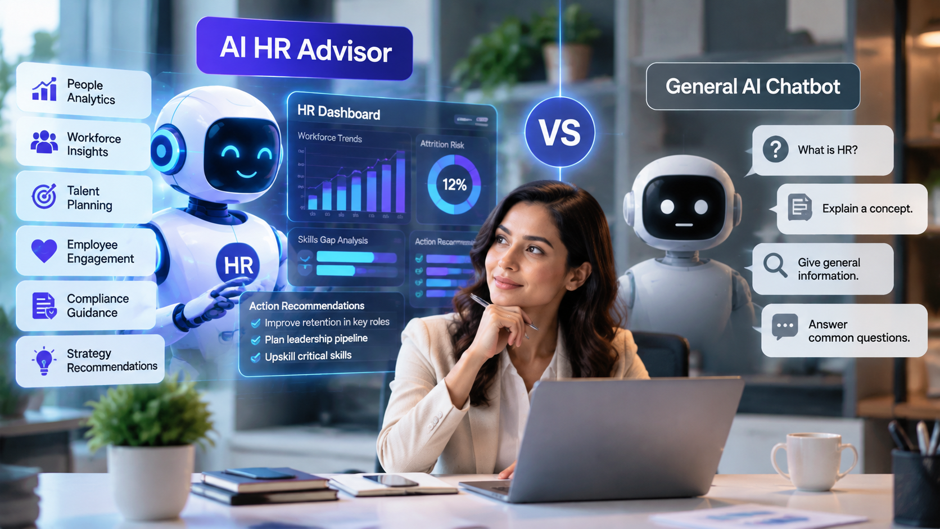
An HR manager asks a general-purpose AI chatbot whether a specific termination in a particular state complies with local notice requirements, gets a confident, well-written answer, and acts on it, only to discover weeks later the answer was subtly wrong, built on outdated or generalized information the chatbot had no way of verifying against the organization’s actual jurisdiction, policies, or current legal requirements. That gap between a confident-sounding answer and a genuinely reliable one sits at the center of why a distinct category of tool, the AI HR advisor, has emerged as something meaningfully different from simply pointing a general AI chatbot at HR questions.
Understanding exactly what separates an AI HR advisor from a general AI chatbot matters considerably more than it might initially seem, particularly as more HR teams evaluate AI tools without always recognizing that “AI-powered” covers a genuinely wide range of underlying capability. This guide works through what actually defines an AI HR advisor, the specific dimensions where it diverges from a general-purpose chatbot, and why that distinction carries real, practical consequences for compliance accuracy, system integration, and the kind of trust an organization can reasonably place in the answers it receives.
TL;DR
| Dimension | General AI chatbot | AI HR advisor |
| Knowledge grounding | Trained on broad, general internet data with no organization-specific context | Built on a proprietary knowledge base of verified employment law and organizational policy |
| System integration | Operates as a standalone tool, disconnected from actual HR records | Reads and writes directly to live HRIS, payroll, and benefits records |
| Compliance reliability | Confident-sounding but unreliable for jurisdiction-specific employment law | Provides verified, source-cited answers specific to the applicable jurisdiction |
| Action capability | Answers questions but cannot trigger downstream tasks or workflows | Connects to systems, triggers tasks, and escalates to a human when needed |
| Personalization | Delivers the same generic response to every user | Reflects the specific organization’s own policies, data, and workflows |
| Governance and oversight | No built-in human-in-the-loop structure for high-stakes decisions | Typically operates on a two-tier model pairing AI with human advisor escalation |
The core distinction across every row above comes down to this: a general AI chatbot answers questions using what it already knows in general, while an AI HR advisor is specifically built to answer using what’s actually true for your organization, and then, in more advanced implementations, to act on that answer rather than simply describing what should happen next.
What an AI HR Advisor Actually Is
Before working through the specific differences in genuine detail, it’s worth establishing clearly what an AI HR advisor actually means as a distinct category, since the term gets used loosely enough today that it’s easy to assume any AI tool touching HR questions automatically qualifies for the label.
The Core Definition
An AI HR advisor is a purpose-built AI system designed specifically to provide HR and employment-related guidance grounded in verified, current information, typically drawing on a proprietary knowledge base covering employment law, organizational policy, and, in more advanced implementations, an organization’s own live HR data. Unlike a general-purpose AI assistant applied to HR questions as one use case among many, an AI HR advisor is built from the ground up around the specific reliability, compliance, and integration demands HR work genuinely requires.
Why This Category Emerged as Distinct From General AI
General AI tools are genuinely unreliable for international employment law specifically, since laws vary considerably by jurisdiction, change frequently, and carry real financial and legal consequences when applied incorrectly, a combination that a general-purpose model trained on broad internet data simply isn’t built to handle with the reliability HR decisions genuinely require. This gap created clear demand for a distinct category of tool built specifically around verified, current, jurisdiction-specific guidance, rather than the broad, generalized knowledge a mainstream AI assistant draws from by default.
Why the Distinction Matters Beyond Just Terminology
Treating any AI tool that can discuss HR topics as functionally equivalent risks exposing an organization to real compliance and operational risk, since the underlying reliability, data grounding, and system integration differ substantially between a general chatbot repurposed for HR questions and a tool genuinely built for this specific purpose. Recognizing this distinction clearly is the first step toward evaluating AI HR tools on the dimensions that actually matter, rather than simply on how fluent or confident the resulting answers sound.
The Core Dimensions Where They Diverge
With the basic definition now genuinely established and clear at this particular point in the discussion, the sections below break down the specific, concrete dimensions where an AI HR advisor and a general AI chatbot genuinely differ from one another in daily, real-world practice and everyday use.
Knowledge Grounding and Source Verification
The specific differences in how each type of tool actually knows what it knows:
- A general AI chatbot draws on broad training data reflecting general internet content, without any built-in mechanism to verify whether a specific answer reflects current, jurisdiction-accurate employment law
- An AI HR advisor typically draws on a proprietary, actively maintained knowledge base specifically covering employment law and regulatory requirements across relevant jurisdictions
- More advanced AI HR advisors provide verified answers with cited sources, giving HR leaders a way to actually confirm the basis for a given answer rather than simply trusting a confident-sounding response
- A general chatbot has no equivalent citation mechanism by default, making it considerably harder to verify whether a specific answer is genuinely current and accurate for the situation at hand
System Integration and Data Access
An AI HR advisor built to genuinely serve as the interface to an organization’s HR system operates fundamentally differently from a chatbot placed on top of that system as a separate layer. The more advanced implementations read and write directly to live HRIS, payroll, leave, and benefits records, meaning an employee asking about their leave balance receives a real-time answer pulled from their actual record, and an employee requesting leave has that request genuinely processed, approved, and confirmed within the same conversation, rather than simply pointed toward a separate system to complete the actual transaction.
Why This Integration Difference Matters Practically
A general AI chatbot, by contrast, typically has no connection whatsoever to an organization’s actual HR records, meaning it can only offer generic, policy-level information rather than anything specific to a particular employee’s actual situation. This distinction matters enormously in practice: a chatbot that can only describe how leave requests generally work is considerably less useful than one that can actually check a specific employee’s current balance and process their specific request directly.
Why “Answers” and “Acts” Represent a Genuinely Different Capability Tier
Beyond knowledge grounding and system integration specifically, a further, genuinely important distinction separates tools that merely answer HR questions from tools genuinely capable of taking real, meaningful action, and this distinction increasingly defines the more mature, advanced end of the entire AI HR advisor category as it stands today.
The Coordination Tax General Chatbots Don’t Solve
A significant share of HR work involves coordination rather than simple information retrieval: a promotion isn’t just a record update, it triggers compensation changes in payroll, access changes in IT systems, approvals across finance, and often new compliance requirements, none of which a single system fully owns end to end. HR professionals have effectively become the manual glue holding these disconnected systems together, copying data between platforms, chasing approvals across email and chat tools, and reconciling discrepancies that arise when systems inevitably fall out of sync with each other.
Why a Chatbot That Only Answers Doesn’t Address This Coordination Burden
A chatbot capable only of retrieving and restating policy text can reduce the volume of basic, first-level questions reaching an HR team, but it does nothing to address the deeper coordination burden driving much of HR’s actual daily workload. A more advanced AI HR advisor, by contrast, connects directly to the relevant systems, triggers the actual downstream tasks a request requires, and recognizes specifically when a situation is complex enough to warrant escalation to a human advisor rather than attempting to resolve it entirely on its own.
What a Genuinely Mature Implementation Looks Like in Practice
The specific capabilities that distinguish a mature, action-capable AI HR advisor from a basic question-answering chatbot:
- Automating a substantial volume of routine HR tasks directly, rather than simply describing how an employee could complete them manually themselves
- Handling a high volume of employee conversations and transactions simultaneously, at a scale no purely human-staffed HR team could realistically match
- Operating on a genuine two-tier model, where AI handles routine, well-defined inquiries directly while human advisors specifically manage more complex, nuanced situations
- Maintaining accessible connection to a comprehensive body of current policy documentation, rather than a fixed, potentially outdated knowledge snapshot
This capability gap between answering and acting is precisely what separates a basic HR chatbot from a genuinely mature AI HR advisor, and it’s the dimension worth weighing most heavily when evaluating how much real coordination burden a given tool will actually remove from an HR team’s daily workload.
Where AI HR Advisors Fit Across the Broader HR Function
Understanding where AI HR advisor capability actually shows up across HR’s full, broad scope of responsibility genuinely helps clarify why this specific category has grown so quickly in recent years, and where it still genuinely has considerably further left to mature and develop over the coming time.
The 7 Pillars of HR and Current AI Maturity
| HR pillar | Typical current AI maturity level |
| Recruitment and selection | Among the most AI-saturated areas, with conversational and agentic tools handling sourcing, screening, and scheduling at high volume |
| Onboarding | Growing AI involvement, though genuine cross-system orchestration remains inconsistent across different vendors and platforms |
| Performance management | Emerging AI use in structuring feedback and analyzing performance signals, generally with clear human approval gates built in |
| Learning and development | AI increasingly used to build personalized learning paths matched to an individual employee’s specific skill gaps |
| Compensation and benefits | More limited AI maturity currently, though this is expanding as compensation benchmarking tools incorporate AI-driven analysis |
| Employee relations | An area where AI HR advisors specifically add value through consistent, policy-grounded guidance on sensitive situations |
| Legal and regulatory compliance | Where the distinction between general AI and a genuine AI HR advisor matters most acutely, given the real consequences of an incorrect answer |
Why Recruitment Became the Most AI-Saturated Function First
Recruitment activity tends to involve high volume, relatively structured, repeatable tasks, screening resumes against defined criteria, scheduling interviews, answering common candidate questions, making it a genuinely natural first area for AI tools to demonstrate clear, measurable value. The EEOC’s AI and Algorithmic Fairness Initiative also reflects why employers need to consider employment-law implications when automated systems influence hiring and other employment decisions, even as the buying decision increasingly shifts toward differentiation between vendors.
Why Compliance Remains Where the AI HR Advisor Distinction Matters Most
While AI has touched nearly every one of these 7 pillars to some degree, the distinction between a general AI chatbot and a genuine AI HR advisor matters most acutely within legal and regulatory compliance specifically, precisely because the consequences of an unreliable answer are considerably more severe here than in a lower-stakes area like scheduling an interview. An organization evaluating AI tools across its full HR function should expect, and genuinely look for, considerably more rigorous data grounding and verification specifically within this pillar than it might reasonably require elsewhere.
The Compliance and Trust Dimension
Given how much HR work genuinely touches legal and compliance risk on a daily, ongoing basis throughout the entire year, the reliability gap between a general AI chatbot and a purpose-built AI HR advisor deserves particularly close, deliberate attention from anyone actively evaluating these specific tools today.
Why Compliance Accuracy Separates the 2 Categories So Clearly
The specific reasons compliance-related questions expose the gap between general AI and a genuine HR advisor most clearly:
- Employment law varies considerably across jurisdictions, and a general AI chatbot has no reliable, built-in mechanism to confirm which specific jurisdiction’s rules genuinely apply to a given question
- Employment regulations change frequently, and a general chatbot’s underlying training data reflects a fixed point in time rather than continuously updated, current requirements
- The financial and legal consequences of an incorrect compliance answer are genuinely significant, making source verification and citation considerably more important than in lower-stakes use cases
- A purpose-built AI HR advisor drawing on an actively maintained, jurisdiction-specific knowledge base directly addresses each of these specific gaps in a way a general-purpose tool genuinely cannot
Why Human-in-the-Loop Design Remains Essential Even for Advanced Advisors
Even the most sophisticated AI HR advisor benefits from a deliberate human-in-the-loop structure, since human judgment remains the most reliable safeguard against bias and the genuine connection employees need during sensitive, high-stakes HR situations. Current human-centered AI guidance for the workplace reinforces the importance of responsible AI use around workers, which is precisely why more mature implementations build in a tier where humans take over complex or sensitive cases.
Why Employee Trust in the Tool Itself Genuinely Matters
A meaningful share of employees report genuine excitement about using AI tools at work, yet a significant share of those same employees still don’t actually use available AI tools even when they genuinely could, often because AI deployment decisions were made without adequate involvement from HR itself. Building employee trust and engagement around an AI HR advisor requires more than technical capability alone; it requires employees genuinely believing the tool’s answers are accurate, current, and specifically relevant to their own actual situation.
Broader OECD research on AI in the workplace also points to worker concerns around data use, inequality, and other workplace risks, which helps explain why adoption depends on trust as much as raw technical capability.
Why Personalization Separates Genuinely Useful Tools From Generic Ones
A further dimension genuinely worth understanding involves exactly how well a given AI tool reflects an organization’s own specific policies, data, and everyday workflows, rather than delivering the exact same generic experience to every single customer regardless of their own actual, particular situation and specific needs.
The Personalization Gap Across Current AI HR Tools
A meaningful share of customers now expect genuinely better personalization as AI technology continues advancing, yet many HR platforms still deliver essentially identical AI features to every customer, the same resume screener, the same basic chatbot, the same standard analytics dashboard, regardless of how different one organization’s actual workflows and needs genuinely are from another’s. This approach works reasonably well for generic, standardized HR processes, but breaks down considerably for organizations with more specialized workflows around things like shift management, industry-specific compliance reporting, or credential tracking unique to a particular sector.
Why an AI HR Advisor Should Reflect the Organization’s Own Data Specifically
The genuine test of whether a given AI tool qualifies as a true AI HR advisor, rather than a generic chatbot wrapped around existing HR software, comes down to a fairly direct question: does the AI operate using the organization’s own actual people data and specific policies, or does it live in a separate window generating generic, one-size-fits-all answers regardless of who’s asking or what organization they belong to? A tool that connects these inputs with talent development and coaching can reflect the specific organization it serves more directly, while a tool failing the test is closer to a general chatbot with an HR-flavored interface layered on top.
What Genuine Scale Looks Like at the Mature End of the Category
Beyond simply describing these capabilities in the abstract, looking closely at what a genuinely mature, large-scale AI HR advisor deployment actually handles in daily, real-world practice helps make the distinction from a general chatbot considerably more concrete, genuinely tangible, and easier to grasp fully and completely.
The Kind of Volume a Mature Deployment Actually Handles
The specific operational scale documented within mature, enterprise-grade AI HR advisor deployments:
- Automating well over 80 distinct HR tasks directly, spanning routine transactions an employee would otherwise need to complete manually through a separate system
- Handling millions of individual employee conversations annually, at a volume no purely human-staffed HR team could realistically sustain on its own
- Processing well over a million actual HR-related transactions in a single year, not merely answering questions about how those transactions work
- Maintaining accessible connection to thousands of pages of current policy documentation, kept genuinely current rather than frozen at a fixed training snapshot
- Achieving genuinely high adoption rates among managers specifically, reflecting real, sustained trust in the tool’s reliability rather than novelty-driven initial usage that fades over time
Why This Scale Simply Isn’t Achievable With a General Chatbot Alone
A general AI chatbot, however fluent and capable in conversation, has no inherent mechanism for actually processing a real HR transaction, updating a live record, or triggering a downstream workflow across connected systems. Reaching this kind of genuine operational scale requires the deep system integration and verified data grounding that specifically defines the AI HR advisor category, rather than conversational capability alone, however impressive that capability might appear in an isolated demonstration or a single, well-crafted sample interaction.
Why the 2-Tier Model Specifically Enables This Scale Without Sacrificing Judgment
The genuine scale mature AI HR advisor deployments achieve depends heavily on the 2-tier structure separating routine, well-defined inquiries handled directly by AI from more complex, sensitive situations specifically escalated to human advisors. This structure allows an organization to achieve genuine efficiency at volume on the routine end of the spectrum, while still preserving the human judgment genuinely necessary for the smaller share of situations where nuance, empathy, or complex judgment calls matter considerably more than speed or consistency alone.
Common Mistakes When Evaluating “AI-Powered” HR Tools
Beyond simply understanding the core distinctions covered above throughout this guide, several recurring, genuinely predictable mistakes show up consistently among organizations evaluating AI tools for HR use, and avoiding them considerably improves the odds of selecting a tool that genuinely delivers on this category’s actual, real promise.
Assuming any AI tool that can discuss HR topics qualifies as a genuine AI HR advisor. A general-purpose AI assistant capable of producing fluent, confident-sounding answers about HR topics isn’t automatically equivalent to a tool genuinely built around verified, jurisdiction-specific employment knowledge and direct system integration.
Prioritizing conversational fluency over genuine data grounding. A tool that sounds impressively knowledgeable in conversation isn’t necessarily drawing on current, verified, organization-specific information, and conversational polish alone shouldn’t be mistaken for genuine reliability on compliance-sensitive questions.
Overlooking whether the tool can actually take action, not just answer questions. Selecting a tool purely for its ability to answer employee questions, without evaluating whether it can also trigger the actual downstream tasks and system updates those questions often require, leaves much of HR’s genuine coordination burden entirely unaddressed.
Deploying AI tools without meaningful HR involvement in the selection process. AI deployment decisions made without genuine input from the HR team that will actually depend on the tool daily consistently produce poor adoption and mismatched expectations, regardless of how technically capable the underlying tool genuinely is.
Expecting full automation without a genuine human-in-the-loop structure. Even the most advanced AI HR advisor still benefits from clear escalation paths to human judgment for complex or sensitive situations, and a deployment expecting complete automation across every scenario risks producing exactly the kind of confident-but-wrong outcome that damages both compliance and employee trust.
Who Should Be Involved in Choosing an AI HR Advisor
Given how consistently poor adoption traces directly back to AI deployment decisions made without genuine HR involvement in the first place, being deliberate about exactly who’s actually involved in evaluating and selecting an AI HR advisor matters just as much as the technical evaluation itself does.
Dividing Evaluation Responsibility Across Key Stakeholders
| Stakeholder | What they should specifically evaluate |
| HR leadership and practitioners | Whether the tool genuinely reflects how HR work actually happens day to day, and whether its answers align with the organization’s real policies |
| Legal and compliance teams | Whether the tool’s compliance guidance is genuinely verified and source-cited, and whether escalation paths for complex situations are adequate |
| IT and data governance teams | Whether system integration is technically sound, secure, and doesn’t introduce unacceptable data privacy or security risk |
| Employees themselves, through a pilot group | Whether the tool’s answers feel genuinely useful and trustworthy in real, everyday use, not just in a controlled demonstration |
| Finance or procurement | Whether the pricing model and total cost genuinely align with the organization’s actual expected usage and scale |
Why Excluding Any of These Stakeholders Tends to Produce Poor Outcomes
A selection process driven entirely by IT evaluating technical integration, without genuine input from the HR practitioners who’ll actually depend on the tool daily, risks selecting something technically sound but poorly matched to how HR work genuinely happens in practice. Similarly, a process driven entirely by HR leadership without meaningful legal or compliance review risks underestimating genuine regulatory risk, particularly for organizations operating across multiple jurisdictions where compliance stakes are considerably higher than a purely HR-focused evaluation might naturally weigh them.
Why a Genuine Pilot With Real Employees Matters More Than a Vendor Demonstration
A polished vendor demonstration, run through carefully chosen example questions, tells an organization considerably less about a tool’s real-world reliability than a genuine pilot involving actual employees asking their own, unscripted questions about their own, real situations. Building a deliberate pilot phase into the evaluation process, rather than moving directly from a demonstration to a full organization-wide rollout, surfaces gaps in data grounding, system integration, and genuine usability that a controlled demonstration environment simply won’t reveal on its own.
FAQs
Can a general AI chatbot like a mainstream assistant ever be safely used for HR questions?
It can be useful for general, low-stakes background research or drafting assistance, but it genuinely shouldn’t be relied on for jurisdiction-specific compliance questions or any decision carrying real legal or financial consequence, precisely because it lacks the verified, current, jurisdiction-specific grounding a purpose-built AI HR advisor is specifically designed to provide.
Is system integration always necessary for a tool to genuinely qualify as an AI HR advisor?
Deep, live system integration represents the more mature end of the category, but a tool without full read-write access to live HR records can still qualify as a genuine AI HR advisor if it’s grounded in a verified, jurisdiction-specific knowledge base and provides source-cited answers, even if it can’t yet directly trigger downstream system actions. The fullest expression of the category does include this integration, though, since it’s what allows the tool to actually act rather than only advise.
How can an HR team practically evaluate whether a vendor’s “AI HR advisor” claim is genuine?
Asking specifically whether the tool operates using the organization’s own actual data and current policies, versus generating generic answers in a separate window disconnected from real records, is one of the clearest practical tests available. Asking whether the vendor can demonstrate source citation for compliance-related answers, and whether the tool has any mechanism for escalating complex situations to a human, are similarly direct, practical ways to distinguish a genuine AI HR advisor from a general chatbot with HR branding applied on top.
Does adopting an AI HR advisor eliminate the need for human HR staff on compliance questions?
No, and it genuinely shouldn’t be expected to. Even the most mature implementations explicitly retain a human-in-the-loop tier specifically for complex or sensitive situations, since human judgment remains essential for preventing bias and maintaining the genuine trust employees need during difficult or nuanced HR situations. The value of a genuine AI HR advisor lies in handling routine, well-defined inquiries reliably and at scale, freeing human HR staff to focus specifically on the situations that genuinely require their judgment.
Why do some HR platforms deliver identical AI features to every customer despite marketing them as personalized?
This often reflects a genuine technical and business tradeoff: building AI that adapts to each specific customer’s own data, policies, and workflows requires considerably more investment than building a single, standardized AI feature set applied uniformly across every account. Many platforms currently prioritize breadth and speed of deployment over this kind of deeper, genuine personalization, though customer expectations around personalization are rising quickly enough that this gap is likely to narrow considerably over time.
Should a smaller organization without complex international compliance needs still care about this distinction?
Yes, though the specific stakes differ somewhat. Even a smaller, single-jurisdiction organization benefits from an AI tool grounded in its own actual policies and current, verified information rather than generic answers, since even domestic employment law changes frequently enough that outdated or generalized guidance still carries genuine risk, just at a smaller scale than a multinational organization managing compliance across dozens of jurisdictions simultaneously.
How does an AI HR advisor typically stay current as employment law and organizational policy change over time?
A genuine AI HR advisor is built around an actively maintained knowledge base specifically designed to be updated as employment law and regulatory requirements evolve, rather than the fixed, frozen training snapshot a general AI chatbot relies on by default. This ongoing maintenance is precisely what allows the tool to continue providing genuinely current, reliable guidance well after its initial deployment, rather than gradually drifting out of date the way a general-purpose model’s underlying knowledge inevitably does without deliberate, continuous updates specifically targeting employment law content.
What’s the realistic timeline for an organization to see genuine value from deploying an AI HR advisor?
Organizations that begin with a focused pilot addressing a specific, clearly defined pain point, rather than attempting a broad, organization-wide rollout from the very start, tend to see genuine, measurable value considerably sooner than those trying to solve every HR coordination challenge simultaneously. A well-scoped pilot focused on a single high-volume, well-understood use case, such as leave balance inquiries or basic policy questions, can typically demonstrate genuine value within weeks, while the deeper system integration and broader organizational trust needed for more advanced, action-capable deployment genuinely takes longer to build and earn.
Does the size of an organization’s HR team change whether an AI HR advisor is genuinely worth adopting?
A smaller HR team often stands to gain proportionally more from a genuine AI HR advisor, since the coordination burden and volume of repetitive employee questions described throughout this guide typically fall on fewer people who have considerably less capacity to absorb that burden manually. A larger HR team may have more internal capacity to handle routine questions through existing staff, but even in that context, a genuine AI HR advisor still frees experienced HR staff to focus on the more complex, judgment-intensive work only they can genuinely handle well.
What happens to the answers an AI HR advisor gives when organizational policy actually changes?
A genuine AI HR advisor built on live integration with an organization’s own systems and policy documentation should reflect a policy update essentially as soon as that update is made, since the tool draws its answers from the organization’s current, actual source of truth rather than a fixed snapshot captured at some earlier point. This stands in sharp contrast to a general AI chatbot, which has no mechanism at all for learning about an internal policy change, and will simply continue giving generic or outdated guidance regardless of what the organization has actually since decided to change.
Is there a risk that employees over-trust an AI HR advisor simply because it sounds authoritative?
Yes, and this risk exists for any AI tool that communicates confidently, regardless of how genuinely reliable its underlying data actually is, which is precisely why source citation and clear escalation paths matter so much in practice. An organization deploying a genuine AI HR advisor should set clear expectations with employees about what the tool handles reliably versus when a human advisor should genuinely be consulted instead, rather than assuming employees will intuitively know the difference simply because the tool’s answers happen to sound confident and well-constructed.
