
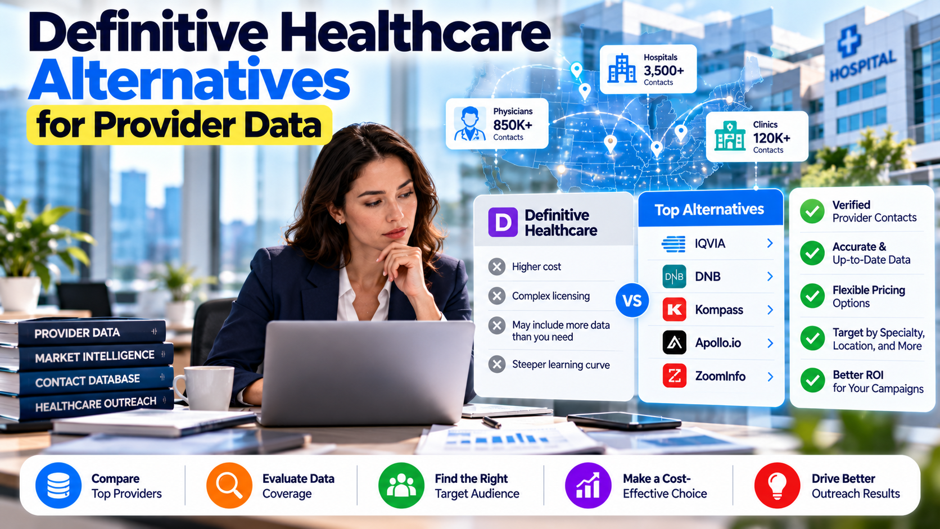
Picture an illustrative marketing operations manager at a company that sells scheduling software to specialty clinics. Her team has used a large healthcare intelligence platform for 2 years, and renewal is 90 days away. The quote rose again, her reps mostly pull contact lists, and nobody on the team has opened the claims modules in months. She wants to know what else is out there for provider data, what each option really covers and what she’d give up by switching.
This article compares categories of alternatives to Definitive Healthcare: contact-focused databases, other healthcare intelligence vendors, public federal files and hybrid setups. It draws on a vendor comparison page from Ampliz, price data reported by Vendr, H1’s product page, a G2 comparison and federal descriptions of the NPI file. Most of those sources sell something, so each claim is attributed. The cost model near the end uses invented numbers. Confirm prices with vendors and legal points with counsel.
TL;DR
- The right alternative depends on the job the data does. Definitive Healthcare is positioned as market intelligence and analytics, according to a competitor’s page, while contact-focused databases target prospecting and recruiting. If your reps mostly pull lists, a narrower tool may cover the work. If you rely on claims-based insight, few substitutes exist, and you should test them before you cancel anything.
- Pricing is opaque, so use reported benchmarks and negotiate. Vendr’s page, as of February 2026, reports a median of about $50,000 a year across 33 purchases, with a range of $20,777 to $255,973. It also says multi-year terms can cut annual pricing by 10% to 20%. Those are third-party reports, so ask for a written quote.
- Test every vendor on your own records before you sign. Public NPI files are free but need cleaning, while paid vendors make accuracy claims that nobody has audited here. Give each vendor 100 providers you can verify, compare the results and measure cost per usable record instead of cost per record.
What the platform sells and why teams look elsewhere
Definitive Healthcare is positioned as intelligence and analytics. Ampliz, a competitor, describes it as strong on market intelligence, with claims and analytics available through relevant products and contact data that depends on the product. Ampliz also says pricing isn’t published and that the platform may be hard to justify when the need is mostly prospect lists. That’s a competitor’s framing rather than a neutral review, so read it as a hypothesis to test rather than a finding.
Buyers leave for several different reasons. A team that wants contact data may find that most of the platform’s modules go unused. A team that wants analytics may want a different data mix or a platform that fits its CRM better. Someone else may simply face a renewal increase. Name your reason before you shop, because it decides which alternative category makes sense. A vendor that fixes your actual complaint beats a vendor that wins a general feature comparison.
G2 shows a mixed picture, with limits. A G2 comparison page lists Definitive Healthcare at 3.9 out of 5 from 43 reviews and Vizient at 4 out of 5 from 16 reviews, with ease of use scoring 8.1 for both. The page shows no review dates and no reviewer profiles, and 43 reviews is a small sample. Use review sites to build a question list for vendors rather than as proof of quality for any product.
Alternative categories at a glance
The table groups the options by what they do best. The “my judgment” column isn’t sourced data, because none of the vendor pages I read compare the categories neutrally. Every vendor listed sells its own product and describes itself favorably. Treat the table as a map for deciding where to look first, then verify each claim with a sample and a written quote before you commit budget to any option.
| Category | Examples named in sources | What it tends to cover | My judgment |
| Contact-focused databases | Ampliz | Provider and hospital contacts, prospecting, recruiting | Fits list-heavy teams |
| Other intelligence vendors | H1, IQVIA, Komodo Health, Vizient | Market, clinical or commercial intelligence | Closest substitutes for analytics |
| Master data and directory vendors | OneKey Data Healthcare, H1 | Provider directories and record management | Fits data management projects |
| Public federal files | NPI Registry and downloadable file | Provider identifiers and basic practice details | Free but needs cleaning |
| Hybrid setups | Combinations of the above | Public base plus a paid contact layer | Often best for tight budgets |
Reasons buyers cite for switching
- Cost at renewal is the most common trigger. Vendr’s page says annual escalators of 3% to 5% are common and suggests negotiating a cap at signing. On a $50,000 contract, that’s $1,500 to $2,500 more each year before any new modules. Teams with flat budgets feel this quickly. Ask what the increase buys, and whether your usage justifies it, before you decide that switching is the only answer to a price rise.
- Unused modules make the price feel high. Vendr’s page describes data modules running about $10,000 to over $100,000 a year, with API access and CRM integrations costing about $15,000 to $75,000 or more. A team that uses 1 module but pays for a bundle may find a narrower product cheaper. Review login and export logs before the renewal call, so you can show which pieces your team really uses. Bring those logs to the renewal call.
- Fit with the CRM and workflow matters. Ampliz lists CRM data transfer and email status filters among its features, which suggests that some buyers want data that lands in the sales system without manual work. Ask any vendor how records sync, how duplicates are handled and what happens to records you’ve already enriched. A tool that saves hours each week may justify a price that looks high on paper. That detail often decides whether the data gets used.
- Analytics needs may have changed. A team that bought claims-based insight for a launch may not need it a year later. If your questions are now about contacts and org charts, the analytics layer is cost without value. If they’re about market sizing and referral patterns, the layer matters and cutting it would leave a gap. Decide which situation you’re in before you compare vendors. Write down the answer for your own team first.
What the public NPI file gives you
A federal file is the cheapest starting point, and it’s easy to overrate. CMS publishes the NPPES data that’s disclosable under the Freedom of Information Act through the NPI Registry, a query-only database updated daily, and through the NPI Downloadable File. A February 2020 HHS announcement says deactivated NPIs appear in the full monthly file with only the deactivation date, and that weekly incremental files cover new, updated and deactivated numbers. It also says active records can’t be suppressed. I couldn’t confirm the full list of fields from the pages I read, so check the data dictionary for what’s included.
The file has practical limits. ResDAC says it’s very large and can’t be opened in Excel, and that historical versions aren’t kept, so you can’t retrieve an earlier snapshot. Neither source I read addresses how accurate or complete the records are, and I haven’t verified that. Treat the file as a base layer for identifiers and basic practice details, then add a paid source for contact data and test the match rate on your own list before you rely on it for outreach.
Pricing signals from reported contracts
The table collects the price figures I found, each with its caveat. Definitive Healthcare doesn’t publish a price list, so everything below comes from third parties reporting what buyers paid or from competitors describing the vendor. Vendr sells negotiation services, which gives it a reason to emphasize savings. Ampliz competes with the platform. Use these numbers to frame a negotiation rather than to predict your quote, since your modules, users and timing will change the result.
| Figure | Reported value | Source and caveat |
| Median annual contract | About $50,000 | Vendr, as of February 2026; 33 purchases |
| Reported range | $20,777 to $255,973 | Vendor; same sample |
| Earlier median | $50,533 | Cited by Ampliz from Vendr; 30 purchases; date not given |
| Average savings off initial quote | 21.09% | Vendor; buyer-reported |
| 1 to 5 users, core platform | $25,000 to $60,000 | Vendor; typical range |
| 10 to 25 users, multiple modules | $100,000 to $250,000 | Vendor; typical range |
| Multi-year discount | 10% to 20% off annual price | Vendr; reported |
| Data modules | About $10,000 to over $100,000 a year | Vendor; add-on cost |
Where other intelligence vendors fit
H1 is the most visible full-platform alternative in what I read. Its site lists products grouped by clinical, medical, commercial, health plan and digital health uses, including Site Universe, HCP Universe, Prescriber Universe, Network Universe and Provider Foundation Data. H1 says it has 200 customers across 6 continents and that 9 of 10 top payers partner with it. Those are vendor claims I haven’t verified, and the page didn’t state a record count or mention claims data. Ask for both in writing.
Several other names appear but with thin detail. Vendor’s negotiation tips mention IQVIA, Komodo Health and H1 as vendors buyers cite when asking for revised pricing, and G2 has comparison pages with Vizient and Intellimed. I didn’t find detailed product or price information for these, so I won’t describe what they cover. Ask each for a data dictionary, a sample and references from buyers with a use case like yours, and compare the answers side by side.
Master data vendors serve a different job. OneKey Data Healthcare appears in Ampliz’s links, and H1 sells master data and directory management products. These tools aim to keep a single clean record of each provider across systems, which matters for health plans and large commercial teams. If your problem is duplicate or conflicting records rather than a shortage of contacts, a data management product may fit better than a prospecting database. Confirm scope with each vendor.
Full platforms trade breadth for cost. Every intelligence vendor in this group sells broad coverage, and that breadth is what you pay for. If you only need a single slice, such as hospital contacts or prescriber lists, ask whether the vendor sells that slice alone. Some do and some don’t, and the answer changes the comparison. A narrow license from a broad vendor may cost less than a broad license from a narrow vendor.
What contact-focused databases offer
- Ampliz is the example the sources describe. Its own comparison page says provider and hospital data is available and that contact data, prospecting and recruiting are its core use cases. It lists a free trial, email status filters and data recency filters at 30, 60 and 120 days, plus CRM transfer. It gives no price. The page contradicts itself on coverage, citing both 9.1 million and 2.6 million healthcare professionals, so ask the vendor which figure is current and what each counts.
- The pitch is lower cost and a simpler workflow. Contact-focused vendors usually sell by seat or by credits rather than through enterprise contracts, which can suit smaller teams. I found no sourced prices for that model in healthcare, so any comparison with the $50,000 median would be a guess. Get a quote at your volume, ask what each credit buys and find out whether unused credits expire at the end of the term.
- Gaps to check before you switch. Ampliz itself says claims and analytics aren’t its primary focus. If your team uses referral patterns, procedure volumes or facility-level insight, a contact tool won’t replace them. Make a list of every report your team runs each quarter, mark which ones depend on analytics, and ask the new vendor to reproduce at least 1 of them with sample data before you decide. Treat that test as a requirement for any serious candidate.
- Data recency filters help but don’t replace verification. A filter that shows records updated in the last 30 days tells you when a vendor touched a record, but it doesn’t guarantee the email works today. Run your own verification on any list before you send, and track bounces by source. A vendor that accepts credits for bounced addresses shows more confidence than a vendor that refuses, and the policy is worth asking about directly.
Why claims data is the hard part to replace
Claims-based insight is the capability that makes the largest platforms difficult to swap out. The sources I read describe it only loosely: Ampliz says the platform offers claims and analytics through relevant products, and H1’s page didn’t mention claims data at all. I didn’t find a sourced description of where any vendor’s claims come from, how many lives or procedures they cover or how often they refresh. Those details matter more than any feature list, so ask for them directly and request documentation.
If your team depends on claims-based insight, treat a switch as a replacement project rather than a vendor swap. List the questions the data answers today, such as which facilities perform a given procedure or which providers refer to which hospitals. Then ask each candidate to answer 3 of them using a sample. A vendor that can’t do so with real data in a trial is telling you something about its coverage, even if its brochure sounds confident.
If your team doesn’t use claims-based insight, you may be paying for it anyway. Ask your current vendor whether a version of the contract without those modules exists, and what the price would be. Vendr’s page says buyers who bundle 3 or more modules at signing reportedly pay 15% to 25% less than those who add them later, which cuts both ways: bundles lower unit costs but make it harder to drop pieces you don’t use.
Negotiating instead of leaving
Start early and use real alternatives. Vendr’s page recommends engaging 60 to 90 days before the target start date and says citing active evaluations of IQVIA, Komodo Health or H1 is reported to produce revised pricing or free add-ons. That’s advice from a firm that sells negotiation help. It’s plausible, yet I couldn’t verify it. A real evaluation, with sample tests and written quotes, is more convincing to a vendor than a bluff, and it gives you data if you do switch.
Ask for multi-year terms with a renewal cap. Vendr reports that 2-year and 3-year terms lower annual pricing by 10% to 20%, and that annual escalators of 3% to 5% are common. My arithmetic on a $50,000 base: a 15% multi-year discount with a 4% escalator gives $42,500, $44,200 and $45,968 over 3 years, or $132,668 in total, against $156,080 with no discount and the same escalator. Those are invented terms, so run your own.
Negotiate API and modules separately. Vendr’s page says API access and integrations carry their own fees, and that usage caps or throttled refresh rates can lower them. If you need CRM sync, ask for it as a line item with its own price and volume limits. Unbundling lets you drop what you don’t use and compare each piece against a cheaper alternative, which is the easiest way to find which parts of the contract carry the most cost.
Time the request. Vendr says quarter-end and year-end timing creates sales urgency. Check your own fiscal calendar and the vendor’s before you set a decision date. Ask for a final written quote with all modules, users, term and renewal terms stated, and have finance and legal review it. Don’t sign a verbal promise about future pricing, and ask counsel to review any clause about auto-renewal, data deletion and permitted use.
Which alternative fits which job
The table maps common jobs to the alternative that usually fits. It’s my judgment rather than sourced data, so test it against your needs. The logic is simple: contact lists favor contact-focused tools, analytics favor intelligence vendors and tight budgets favor a public base with a small paid layer. Most teams use more than 1 job, which is why hybrids come up so often when people describe how they actually buy provider data.
| Job | Usually fits | Why (my judgment) |
| Build outbound lists of providers and hospital contacts | Contact-focused database | Priced for list work, lighter on analytics |
| Size a market or find referral patterns | Intelligence vendor | Needs richer data than contacts |
| Keep a clean provider directory across systems | Master data vendor | Built for matching and record management |
| Validate NPI numbers and basic details | Public federal files | Free and updated on a regular schedule |
| Tight budget, sales team of 5 or fewer | Public base plus contact layer | Lowest cost if someone can clean data |
| Mixed needs across marketing, sales and analytics | Hybrid | Pay for each capability separately |
Questions to ask every vendor
- Where does each field come from, and how often is it refreshed? Ask for the source categories, such as public filings, licensed data and vendor research, and for the refresh schedule by field. A vendor that answers in specifics shows it tracks its own data. A vendor that gives marketing language leaves you guessing. Put the answer in writing and keep it with the contract, because it’s the basis for judging whether the data meets the promise later.
- What’s your match rate on a sample I provide? Send 100 providers you can verify and ask for the percentage found, the percentage with a valid email and the percentage with a correct specialty. Check the results yourself. Repeat the test with each candidate using the same list so the numbers compare fairly. This single test reveals more about fit than any brochure, and a vendor that refuses it deserves less weight in your decision.
- What happens when an address bounces? Ask about credits or replacements, the window for reporting bad records and any bounce rate that triggers a refund. A clear written policy tells you the seller stands behind its data. Ask whether credits apply automatically or only after you file a claim, how long the vendor takes to respond and whether credits can be applied to the renewal. Record each answer in writing for later reference.
- What are the usage limits and renewal terms? Ask about seat counts, export caps, API limits, auto-renewal, escalator caps and what happens to your data on exit. Vendr’s page reports annual escalators of 3% to 5% as common, so ask for a cap in the contract. Ask counsel to review any clause about permitted use, since the rules for contacting providers vary and I haven’t researched them. Get every answer in the written quote.
The hybrid approach
- Use prebuilt data for breadth and custom work for priority accounts. Instantly suggests using a data broker only for narrow cases such as hyper-niche segments or short, time-sensitive tests. A mirrored plan for a custom build might reserve it for your top accounts, where each contact matters, and use prebuilt data for the long tail. Define the tiers in advance, with the deal value and fit criteria that move an account from a lower tier to a higher tier.
- Verify everything before it enters a campaign. Instantly advises verifying any broker data before use, and says that if it can’t be verified, you should send from a separate, lower-priority domain with a stricter daily cap. It warns against blending unverified broker data into a verified list, since doing so raises bounce rates across the whole campaign. Follow the same rule for any source, including a custom build, and keep unverified records out of your main sending stream.
- Ask providers for refreshments, samples and credits. Instantly lists questions for any provider: its refresh cadence, a sample to test, a bounce-back credit policy and its contract terms. Add a question about source documentation and about what happens to records you stop using. A provider that welcomes a sample test and puts credit terms in writing signals confidence in its data, while a provider that avoids those requests deserves caution. Keep every answer in writing.
- Assign ownership. Instantly recommends giving list operations, meaning sourcing, verification and hygiene, to a single person in revenue operations, and keeping sequence copy and reply handling with the sales development team. Whatever the structure, name an owner for data quality. Without an owner, list problems become everyone’s problem and nobody’s job, and the payback you measured at the start erodes quietly as records age and duplicates accumulate. Review that owner’s results every quarter with finance.
How to run a sample test
Build a test list you can check. Choose 100 providers across your target specialties and regions, including some you know personally or through customers. Include a few who changed jobs recently and a few with common names, because those cases expose weak matching. Record the correct specialty, practice location and contact details yourself before you send the list, so a baseline exists that doesn’t depend on any vendor’s output or claims.
Score the results the same way for each vendor. Count how many records the vendor returned, how many had correct names and specialties, how many had working emails after verification and how many were stale. Calculate cost per usable record by dividing the quoted price by the number of records that passed your checks. Keep the scoring sheet simple, and have someone who didn’t run the test review it so that bias doesn’t creep into the numbers.
Include the public files in the test. Match your list against the NPI file and see how many providers you can identify and how many practice locations agree with your baseline. This costs only staff time and tells you how much a paid source adds on top of a free file. If the free file covers 90% of what you need, the paid tool must justify itself on the remaining 10%, which is usually contact data.
Test again after 30 days. Data ages, and a record that looks right today may be stale next month. Send a small campaign to the verified subset and track bounces and replies. Ask vendors how quickly they correct records you report, and whether corrections flow back to your CRM. A vendor that fixes errors fast and tells you what changed is worth more than a vendor with a slightly higher match rate but no correction process.
Compliance and data use
Federal files come with terms. The HHS announcement says active NPI records can’t be suppressed, but I haven’t verified what uses the data permits or what privacy rules apply to contacting providers. Read the terms on the CMS site, and ask counsel what rules apply to your outreach. The existence of a public record doesn’t answer every question about how you may use it for marketing, and the rules differ by channel and jurisdiction.
Email rules apply whatever the source. Sender, an email platform, summarizes the FTC’s CAN-SPAM rules and says there’s no business-to-business exception, with a working opt-out honored within 10 business days. I couldn’t open the FTC guide itself, so confirm the details with counsel. An article by Howard Sewell of Spear Marketing Group, published on CustomerThink in December 2023, says Google’s bulk sender rules require a spam complaint rate below 0.3% for large senders. Check Google’s current documentation.
Ask vendors about their own compliance. Request a description of how the vendor sources contact data, what consent or notice applies and how it handles opt-out requests and deletion. Ask whether it’ll indemnify you if its data causes a legal problem, and get the answer in the contract. Keep records of where each contact came from and when you verified it, so you can respond if a provider asks why you contacted them.
Treat patient data separately. Provider directories and prospecting data aren’t patient records, yet some intelligence products use claims-based or patient-level information. Ask each vendor how it de-identifies data and what rules apply to your use of it. I haven’t researched the rules for those products, so have counsel and your privacy officer review any contract that involves claims, patient or clinical information before you sign. Document the review in your vendor file for future audits.
Mistakes teams make when replacing a data vendor
- Switching before defining the job. Teams often leave because of price and then discover that the new tool lacks a capability they used every week. Write down what the current platform does for you, rank each item by business value and check each candidate against the list. A short list of must-have reports and fields prevents surprises after the contract starts and makes the vendor conversations much more specific. Share that list with every vendor you contact.
- Trusting a competitor’s comparison page. Ampliz’s page recommends Ampliz, its figures contradict each other and it gives no price. Vendr’s page promotes negotiation help. H1’s page lists products without a record count. All of these are useful sources of questions, yet none is an audit. Verify with samples, references and written quotes, and treat a vendor’s description of a rival as marketing. Ask each vendor for references from buyers with a similar use case.
- Comparing price per record rather than cost per usable record. A cheap file with a high bounce rate or stale titles costs more per usable contact than a pricier file with better accuracy. Compute cost per usable record from your own test, and include staff time for cleaning and verification. The public NPI file looks free until you count the hours someone spends matching and fixing records. Ask each vendor to price against your test results.
- Ignoring exit terms. Auto-renewal clauses, data deletion rules and export limits decide how hard leaving is later. Ask for the right to export your enriched records, a clear notice period and a renewal cap. Counsel should review these clauses. A good contract protects your options for the next renewal, which is the moment when you’ll have the least time and the least bargaining power. Put the exit plan in your calendar 6 months before renewal.
An illustrative cost model
An invented company needs 8,000 provider records. Option A is an enterprise platform at $50,000 a year, using the Vendr median as a stand-in, with an invented 90% usable rate. Option B is a contact-focused database at an invented $12,000 a year with an invented 80% usable rate. Option C is the public NPI file plus staff cleaning, with 120 hours at an invented $45 an hour, $0.01 a record for verification and an invented $3,000 for a paid contact layer, with an invented 60% usable rate. Every input is invented.
| Item (invented) | A: Enterprise platform | B: Contact database | C: Public base plus staff |
| Annual cost | $50,000 | $12,000 | $8,480 |
| Usable rate | 90% | 80% | 60% |
| Usable records | 7,200 | 6,400 | 4,800 |
| Cost per usable record | About $6.94 | About $1.88 | About $1.77 |
| Cost per record needed (8,000) | $6.25 | $1.50 | $1.06 |
| Analytics included | Yes | Limited | No |
Option C is the cheapest per usable record in this example, yet it produces the fewest usable records, so it can’t fill the full need on its own. Option A costs about 3.7 times as much per usable record as option B and only wins if the team uses the analytics it adds. The result flips with different inputs, so replace each invented figure with your sample-test results before you draw any conclusion.
FAQs
What are the main alternatives to Definitive Healthcare for provider data?
The sources I read name Ampliz as a contact-focused alternative, H1 as a full intelligence platform, and IQVIA, Komodo Health, Vizient and Intellimed as names buyers compare. OneKey Data Healthcare appears as a directory vendor, and CMS publishes free NPI files. Every vendor source is self-interested, so request a sample from each candidate and compare results on your own provider list before you decide. Ask each vendor for a quote at your volume and term.
How much does Definitive Healthcare cost?
It doesn’t publish a price list. Vendr’s page, as of February 2026, reports a median of about $50,000 a year from 33 purchases, with a range of $20,777 to $255,973, and typical contracts of $25,000 to $60,000 for 1 to 5 users. These are third-party reports from a firm that sells negotiation services, so ask the vendor for a written quote based on your users, modules and terms. Get the quote in writing.
Is there a free alternative for provider data?
CMS publishes the NPPES data that’s disclosable under the Freedom of Information Act through the NPI Registry and the downloadable file, with weekly and monthly updates according to federal and university descriptions. The file is very large and needs data tools, and I couldn’t confirm which contact fields it includes or how accurate the records are. Check the data dictionary and test the match rate on your list. Plan for staff time to clean it.
Can a contact database replace claims-based analytics?
Probably not. Ampliz itself says claims and analytics aren’t its primary focus, and H1’s page didn’t mention claims data. If your team relies on referral patterns or procedure volumes, ask each candidate to answer 3 of your real questions using a sample before you cancel anything. If your team only pulls contact lists, a narrower tool may cover the work at a lower cost. Ask each vendor for a trial that uses your real questions.
How should I test a provider data vendor?
Build a list of 100 providers whose details you can verify, send the same list to each vendor and score the results the same way. Count matches, correct specialties and working emails after verification, then divide the quoted price by the number of usable records. Add a 30 day follow-up to see how quickly records go stale, and run the same list against the public NPI file. Repeat the scoring after each vendor responds.
Can I negotiate the renewal instead of switching?
Often, according to Vendr, which reports average savings of 21.09% off initial quotes and says multi-year terms cut annual pricing by 10% to 20%. It also recommends starting 60 to 90 days early and citing active evaluations of other vendors. Vendr sells negotiation help, so treat the figures as reported rather than guaranteed. Get a written quote with all terms, and ask for a renewal cap. Compare the savings against the cost of switching.
What compliance issues apply when I use purchased provider data?
CAN-SPAM has no business-to-business exception, according to Sender’s summary, and the opt-out must be honored within 10 business days. Large senders face Google’s bulk sender rules, including a spam complaint rate below 0.3%, according to a 2023 article that you should check against current documentation. Other laws may apply, and I haven’t researched them, so have counsel review your plan and the vendor contract. Keep records of each contact’s source and verification date.
What’s the biggest mistake when replacing a data vendor?
Leaving over price without defining what the current platform does for your team. Teams then find that a report or field they used weekly is missing. List your must-have reports and fields, rank them by business value and test each candidate against the list with a sample. Also read exit terms, since renewal caps, export rights and deletion rules decide how easy the next change will be. Review these terms with counsel before you sign anything.
