
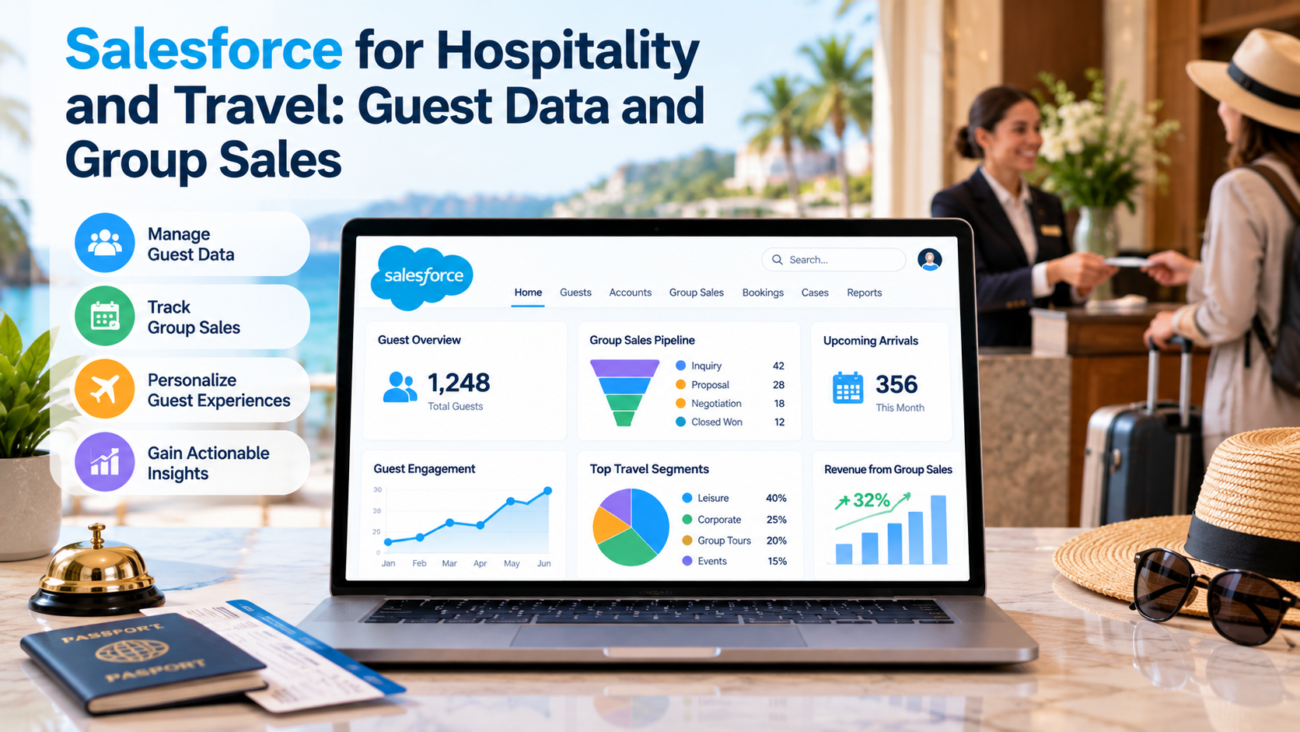
A hotel can recognize a returning guest at the front desk and still fail to recognize that same person in its call center. The guest booked through a travel website last year, joined the loyalty program later, and emailed the property about a future stay. Each system kept a different part of the relationship. The sales team has a similar problem when a meeting planner asks 3 properties for space and no one can see the full request. If you need hands-on help, HyphenX offers Sales Cloud for teams in this position.
Salesforce for hospitality can help staff connect these interactions, provided the business knows which records belong in Salesforce and which must stay in the hotel systems. Guest identity and group business need different workflows. One concerns a person and their stays. The other concerns a contracted event, the company paying for it, and the inventory a hotel may commit.
This guide explains the guest data model, the group sales process, the integration choices, and the controls needed to keep information accurate. It focuses on decisions a hotel group, resort operator, or travel business can make before buying software or changing existing systems.
TL;DR: Salesforce can give hospitality staff a shared view of guest relationships and group business when it receives reliable records from the property management system and other booking tools. A hospitality CRM should keep the reservation system in charge of live room inventory, rates, and confirmed stays. Hotel guest data management requires stable guest IDs and rules for consent and duplicate profiles. Hotel group sales needs a separate pipeline for RFPs, tentative holds, signed agreements, and room-block pickup. Hotel PMS integration should move only the fields each team needs, report failed updates, and preserve the original source. Start with 1 property or group-sales team and verify every milestone against the source system before expanding.
What Salesforce Can and Cannot Own in a Hotel Business
Salesforce is built to manage relationships, work queues, and sales activity. In a hotel, that can mean a shared record of guest contacts, service issues, corporate accounts, travel agents, and pending group opportunities. It can also help a reservations team see the context of an inquiry without opening several unrelated systems.
In Salesforce for hospitality, the property management system, or PMS, usually owns actual reservations, room assignments, check-in and check-out status, and the room folio. A central reservation system may control availability across channels. A booking engine handles direct web reservations, while a revenue system may recommend rates. Salesforce for hospitality should read the right signals from these systems without becoming a second authority for live inventory.
Salesforce describes the role of hospitality CRM software in connecting guest information with service and marketing activity. That is a product direction, not a guarantee that a standard subscription includes ready-made links for every PMS. The actual deployment needs a licensed feature check, data map, and integration plan.
Group business adds another boundary. A salesperson can develop a meeting opportunity in Salesforce, but a confirmed room block must reach the system that controls hotel inventory. If an offer is signed and the PMS does not reflect the block, the CRM may show a win that the hotel cannot deliver. The contract record and inventory release process must agree.
The best role for Salesforce is therefore precise: retain relationship history, assign work, track commercial decisions, and show verified operational updates. That scope gives each department a useful view without asking front-desk staff to maintain 2 copies of a reservation.
Building a Reliable Guest Profile Across Properties
A useful profile in Salesforce for hospitality connects stays that belong to the same person while keeping separate guests apart. Hotels commonly hold names in the PMS, direct booking engine, loyalty database, email system, and service desk. One guest may have several email addresses. A shared family email may represent 2 different travelers. Names can change or be entered differently by an agent.
Hotel guest data management begins with source identifiers. Keep the PMS guest ID, loyalty member ID when available, reservation reference, and Salesforce contact reference in a controlled mapping. Do not use an email match as proof of identity on its own. An uncertain match should go to a review process rather than quietly combining people and exposing one person’s stay history to another.
The Wyndham customer story describes how connected reservation, loyalty, and CRM information helped its service agents find guest context. Its reported outcomes belong to that company’s setup. A smaller hotel should not assume that the same data volume, products, or measured gains will apply to its own properties.
What Belongs on the Guest Record?
A practical profile can show preferred name, contact method, loyalty status if authorized, recent stays, upcoming reservations, and unresolved service cases. It may also include an accessibility request that staff need to fulfill. Sensitive preferences deserve careful access rules and retention limits. A note about a medical condition should not become a permanent marketing tag because someone entered it during a stay.
The source of each field matters. A guest may update their contact details through the loyalty portal while the PMS still holds an old telephone number. Decide which source wins and what staff can correct locally. Add last-updated dates so an agent can distinguish current consent from an old import.
Salesforce’s identity resolution discussion explains match rules and reconciliation rules that can connect records from different sources. Identity resolution creates linked views under defined rules; it should not be treated as a reason to erase the original records or skip checking ambiguous matches.
For hotel guest data management, the goal is confidence in each profile, not the highest possible merge rate. A guest view that hides uncertainty can cause a far more serious service failure than showing 2 records for staff to investigate.
Connecting Salesforce to the PMS and Booking Systems
Hotel PMS integration is the technical work that turns a useful CRM plan into a dependable daily process. It can send approved contact updates to a hotel system or return reservation events to Salesforce. The supported direction varies by PMS vendor, API, deployment, and connected property. A connector described as supporting a hotel brand does not automatically support every PMS version used by that brand.
For hotel PMS integration, start with an inventory of systems. Note which one creates the reservation, which receives changes from online travel agencies, and which stores guest folios. Identify the source of group room blocks separately. Some hotel groups use different systems at different properties, so even basic terms such as reservation status may need a translation table.
Salesforce documents a Hotel Gear data feed for bringing booking and add-on information into a specific Marketing Cloud Personalization setup. It is useful evidence that booking data can support guest segmentation. It should not be mistaken for a universal reservation-writing connector or a standard feature in every Salesforce product.
Events, Scheduled Updates, and Error Queues
A confirmed check-in might need to reach the service team quickly. A completed stay summary can often arrive later in a batch. Define the required freshness by use case. Sending every change in real time increases traffic and does not improve a report that is reviewed once each morning.
When Salesforce calls an external API, the named credentials guide explains how endpoint and authentication settings can be kept outside application code. The hotel still needs a process for service account access, token expiry, secret rotation, and separation of test and production environments.
In Salesforce for hospitality, every integration must record failed messages and the record affected. If a PMS rejects an unknown rate code, sending the same request again without correction may create noise. Temporary outages need controlled retries and duplicate-safe transaction IDs. Hotel PMS integration must also handle cancellations and reservation changes; a feed that only creates bookings soon becomes wrong.
After hotel PMS integration, a nightly comparison of selected PMS totals and CRM-linked reservations can reveal silent gaps. Keep the PMS reservation ID and the last confirmed update time visible. That makes it easier to tell whether a missing booking is a real operational issue or a late message.
Designing the Group Sales Pipeline From Inquiry to Contract
Hotel group sales starts when a company, association, wedding organizer, or travel planner asks for room nights or meeting space. An RFP is a request to quote, not a booking. A tentative hold is different from a signed agreement. A contracted group may still produce fewer occupied rooms than originally expected. Salesforce should represent these separate facts.
The Salesforce sales model includes accounts, contacts, opportunities, quotes, contracts, and related objects. Those records provide a starting structure for group opportunities. Hotels often need extra fields or related objects for arrival patterns, event dates, room blocks, and property-level proposals.
A practical sequence is Inquiry Received, Qualified, Availability Reviewed, Proposal Sent, Tentative, Contract Sent, Definite, Lost, or Canceled. Define each stage using an event that staff can verify. Definite should have a signed agreement and an approved inventory handoff, according to the hotel’s policy. A salesperson changing an opportunity to Closed Won must not independently create inventory that the reservations team has not confirmed.
| Stage | Required Evidence | Primary Next Action |
| Inquiry received | Source and event dates captured | Assign account owner |
| Qualified | Group size and requirements checked | Request availability |
| Proposal sent | Approved rates and terms sent | Track response deadline |
| Tentative | Hold approved under hotel policy | Watch hold expiry |
| Contract sent | Current agreement issued | Resolve changes and signatures |
| Definite | Agreement accepted and handoff recorded | Confirm block in inventory system |
| Lost or canceled | Reason and decision date recorded | Release any permitted holds |
This distinction keeps a sales forecast separate from a committed room count. It also gives managers a fair way to compare response speed and conversion across properties without treating every inquiry as a promised event.
Turning Group RFPs Into Comparable Proposals
A group RFP often comes through a form, agency, event platform, or direct email. It may ask for a meeting room while leaving the sleeping-room pattern unclear. Another may name a preferred property even though the planner will consider several cities. Without a standard intake process, salespeople spend time producing offers that can’t be compared.
The 2026 group travel report from U.S. Travel describes strong underlying RFP demand alongside uneven activity after 2025. Those findings show why response discipline matters, but they do not tell any specific hotel what share of its inquiries will convert. The hotel’s own lead quality and market conditions still decide that.
Hotel group sales intake should capture event type, organization, decision maker, requested dates, estimated rooms per night, meeting requirements, and proposal due date. Ask which requirements are firm and which can move. A one-day date change or a different room setup might make an otherwise unsuitable property workable.
Compare Offers on the Same Basis
A proposal should state the quoted room rate basis, taxes and required fees as applicable, food and beverage assumptions, meeting space charges, and the main conditions. Do not place a single total in Salesforce if one property included breakfast and the other excluded it. Sales staff need a clear price version and an approval trail when revenue management changes the terms.
Keep the quote linked to the opportunity and the exact property. If several hotels respond, preserve each offer instead of repeatedly changing a single amount. Store the reason the client declined when it is known, but avoid guessing that price caused a loss simply because no answer came back.
For Salesforce for hospitality, the proposal deadline belongs in the follow-up queue. A reminder can flag a draft that has not been approved or a planner response that is due. Human review should remain in place for negotiated terms and any inventory commitment. Sending a quote automatically is helpful only when its numbers have been checked against current availability.
Managing Room Blocks, Pickup, Cutoffs, and Attrition
Room-block tracking is where a group-sales pipeline meets hotel operations. The contract may set a number of rooms for each night, a cutoff date for bookings at the group rate, and conditions for unused inventory. Salesforce can show these commitments, but the PMS or group inventory system must remain the source for rooms actually held and booked.
Keep the room-block shape by night instead of storing only a total. A 3-night event can have a large arrival-night peak and a smaller final night. Revenue managers need the nightly pattern to judge displacement risk. A contract total alone may hide a night when the hotel has already sold most of its rooms.
Understand the 4 Counts That Matter
The requested block is what the planner initially wants. The approved block is what the property agrees to hold. Pickup is the rooms or room nights actually booked against that block under the property’s definition. The remaining block is the amount still open for eligible reservations. These quantities can change after an amendment or cutoff.
Attrition terms belong to the signed contract. They describe how shortfall obligations may be calculated, subject to the actual language and governing law. The sales dashboard should display the relevant clause reference and alert the owner when pickup is low. It should not calculate a payable penalty from a standard percentage when the agreement uses a different basis.
Related reading: Salesforce Integration With QuickBooks, NetSuite, and Sage: Options Compared
Group sales teams also need to distinguish wash from cancellation. Wash is the gap between an earlier block forecast and eventual rooms sold. Cancellation may end the event entirely. If the CRM treats both as Lost without dates, managers cannot tell whether the original forecast was poor or the market changed after signing.
Before releasing inventory, confirm who has authority to act. The cutoff may release unsold rooms under the agreement, while some rooms remain available at other rates. A Salesforce workflow can alert the team and store the decision, but it shouldn’t change live availability until the owning system accepts the change.
Managing Corporate Accounts and Multi-Property Relationships
A hotel company may negotiate business with a corporate travel buyer while individual travelers book in different cities. Account managers need to see the corporate agreement and its contacts, but each property still needs a record of the stays it actually hosted. A well-structured hospitality CRM can connect those 2 views without mixing individual guest records with corporate contracts.
Keep the company as an account, then link travel managers and event planners as contacts with clear roles. A corporate negotiated rate belongs to its agreement and eligible properties. The rate should not be copied as an ordinary preference on every employee’s personal profile. An agent should verify eligibility through the rate or reservation system before quoting it.
For multi-property hotel group sales, assign a lead property or cluster owner and record the properties invited to quote. One client inquiry can produce several property proposals, but management should be able to count it as 1 original request. Otherwise, a 4-property bid looks like 4 unrelated new opportunities and inflates the sales funnel.
Conflict rules matter here. A corporate contact may move to a new employer or an agency may change account managers. Keep dated relationship history and current ownership separately. The old opportunity should retain its correct company association for reporting and contract review, even when a new contact becomes the main decision maker.
Handing a Signed Event to Hotel Operations
Closing a group deal is the beginning of a separate delivery process. Sales agrees on commercial terms. Conference services, banquet staff, front desk, and reservations teams carry them out. The handoff should be a defined event with approved versions of the contract and a named operational owner.
Hotel group sales often breaks down when a quote is amended after signing and the property works from the earlier copy. The CRM should link the signed document, amendments, the current rooming-list deadline, and special commitments that the operations team must acknowledge. Keep large attachments in an approved document system where possible, with access limited to the staff who need them.
For automatic status updates, Salesforce’s change event guidance explains event delivery and a limited replay window. That window is not a long-term event archive. A handoff service needs its own log and a recovery check so it can confirm that the property received an important change after an outage.
A complete handoff record might show that operations accepted the event, which system created the group code, and whether the block is active. If an agreement promises a room type that the PMS cannot hold, the discrepancy must go back to sales and revenue management for resolution before the planner is told that everything is confirmed.
After the event, the same record can support a closeout review. Match final pickup and approved group charges to the contracted terms. A completed event with an unresolved billing dispute should not be reported as fully closed for every business purpose.
Using Guest History in Service and Marketing
Hotel guest data management should make a staff decision easier. A reservations agent may benefit from knowing that a caller has an upcoming stay at another property. A service agent may need an unresolved complaint. A marketing team may want permission to send a return-stay offer. These jobs require different views and different reasons to use the information.
For hotel guest data management, collect preferences with a stated purpose and a way to correct them. A guest who requested a quiet room once may not want that choice made on every future trip. Show the source and date when a preference may have changed. Avoid automatically copying detailed service notes into campaign lists.
A hospitality CRM can support pre-arrival messages and post-stay surveys when the hotel has the proper contact permissions. Transactional messages need to stay distinct from promotions. The FTC’s CAN-SPAM business guide explains that commercial email rules apply to business email as well as consumer campaigns. A booking confirmation should not become an excuse to send unrelated offers without checking the message’s purpose and legal requirements.
A returning guest’s previous complaint may justify a service follow-up. It should not automatically label the person as difficult. Let staff view the facts of the case and what was resolved. Small choices like these affect whether staff trust a shared profile enough to use it when the lobby is busy.
The same principle applies to travel businesses outside hotels. A tour operator may use trip history for service, but departure inventory belongs to the booking system. An airline or transport company has different operational records. Salesforce for hospitality is a useful planning concept only when the data model reflects the actual trip and service process.
Protecting Guest Data and Keeping Access Limited
Hotel guest data management brings privacy risk because travel records reveal where someone stayed and when. A single profile may combine passport details, family travel, and loyalty activity across years. Salesforce should not receive that information merely because an integration can send it. Determine the minimum fields needed for each job and keep sensitive identity documents in systems approved for that purpose.
The FTC’s Marriott security order followed allegations about major breaches of guest records. The case is a reminder that combining large guest datasets requires access controls, logging, retention policies, and incident response. It doesn’t mean every hotel is subject to the exact same order.
Payment data requires its own boundary. Under the PCI Security Standards Council’s card verification guidance, card verification codes must not be stored after authorization, even with customer permission. Keep card processing in approved payment systems. A CRM should usually store payment status or a safe token reference rather than card details copied from a front-desk note.
Privacy obligations also depend on place and business coverage. The California agency’s consumer privacy rights include access, correction, and deletion rights subject to conditions and exceptions for businesses covered by the law. A hotel group with properties and guests in several jurisdictions needs an agreed process to carry applicable requests across connected systems.
In a hospitality CRM, staff roles should determine which records and fields they can see. An event planner needn’t open a guest’s loyalty history. A central agent may need stay dates but no medical note. Review exports, reports, and partner portals as carefully as record screens. Hotel PMS integration must also respect deletion or correction actions where the applicable rules require them.
Reporting Guest Relationships and Group Revenue Correctly
The first reporting rule is to say what each number means. A reservation created in the PMS, a group opportunity won in Salesforce, and a room night actually occupied are different events. If dashboards mix them, a growing pipeline may be mistaken for recognized room revenue.
The U.S. Travel forecast published in 2026 projects domestic group travel spending growth for that year. It can provide market context, but it can’t replace property-level demand forecasts. Hotels still need their own seasonality, booking window, and cancellation history when judging whether the pipeline is healthy.
For hotel group sales, useful measures include RFP response time, proposal-to-contract conversion, tentative business aging, definite room nights, pickup against block, and actual group revenue after the event. Define the date basis for each report. A contract signed in March for a November meeting belongs to one sales period, while the hotel stay belongs to another operating period.
Guest reporting needs a separate set of definitions: known repeat guests, linked stays, open service cases, permitted campaign responses, and identity match exceptions. A guest count should say whether it represents unique people, loyalty accounts, or PMS profile records. These may differ even after identity matching.
A Salesforce for hospitality review should reconcile critical totals to the PMS and finance system. Examine missing property IDs, duplicate group opportunities, and event dates that changed after a contract was signed. A reliable report explains an exception before a manager makes a rate or staffing decision from it.
Costs, Product Choices, and the Real Scope of Setup
The cost of Salesforce for hospitality varies with the licensed products, number of users, properties, integration volume, and custom work required. A project may use Sales Cloud for group opportunities, Service Cloud for guest cases, and additional licensed products for identity matching or messaging. Those product names do not mean the features are bundled together for every buyer.
When planning Salesforce for hospitality, budget for more than user licenses. Data cleanup can be substantial when properties use different guest ID practices. Hotel PMS integration may involve vendor connection fees, middleware, API support, and ongoing monitoring. Group sales teams may need quote controls, approval rules, and a separate event system connection. Each addition needs a named owner after launch.
The American Hotel & Lodging Association’s industry cost report describes pressure from hotel operating costs, including technology-related expenses. That context supports close cost review, but it does not establish a price for a Salesforce deployment or predict savings at any individual property.
A proposal should state exactly which guest and group records will move, how often, and who repairs failures. Ask whether the integration handles booking amendments and cancellations, whether a second PMS requires new work, and how retired properties are managed. Compare the full recurring cost with staff time spent on manual reconciliation and the business risk of wrong inventory.
Start with the smallest scope that solves a verified problem. A shared guest lookup and a separate, controlled group opportunity board are often better first releases than replacing every booking and event workflow at once.
An Implementation Plan That Can Survive Live Operations
Begin by mapping 2 real workflows: a guest who books through one channel and calls another property, and a planner who requests a group block before signing a contract. Identify what each user must see, who owns each field, and which system confirms the final event. This produces a testable design for Salesforce for hospitality without forcing every department into the same data record.
Next, choose a pilot property or small sales cluster. Import only the records needed for that scope. Test guest matching where names are similar and when an email is shared. Test a group proposal with several properties, a revised offer, and a signed agreement. The PMS must confirm any room block before the opportunity is treated as operationally ready.
Use a release checklist tied to failure cases:
· A reservation changes in the PMS and the linked guest view receives the correct status.
· A canceled booking does not remain in a guest’s upcoming stays.
· An uncertain guest match is flagged rather than merged without review.
· A tentative room hold expires or is extended under the approved policy.
· A signed group contract produces the correct inventory handoff and property reference.
· A failed connection can retry without making duplicate bookings or group records.
· An access test confirms that unauthorized staff cannot view restricted guest details.
A hospitality CRM rollout needs a clear support path. Front-desk staff cannot wait for the original project developer to investigate every missing reservation. Provide a way to report mismatched records with the source ID and timestamp. Name people from both operations and IT who can correct them.
Expand after the pilot reconciles with the PMS and group sales staff accept the workflow. Properties with different software may need a revised mapping instead of a copied configuration. Train teams using real role-based screens and cases that failed during testing, not just a successful demonstration.
Where Guest Data and Group Sales Meet
Salesforce for hospitality is most useful when it answers 2 different questions without confusing them: who is this guest, and what has this company agreed to buy? The guest profile needs reliable identity and permission rules. The group opportunity needs dated proposals and verified room-block commitments. Both need clear owners when information changes.
Hotel guest data management earns staff trust when a record shows where information came from and when it was checked. Hotel group sales reporting earns management trust when committed business matches the inventory and contracts held by the property. A hospitality CRM can support both, as long as the PMS and the event delivery process keep control of the operational facts.
Frequently Asked Questions
Can Salesforce Replace a Hotel PMS?
Usually, no. A PMS handles live reservations and operational room records. Salesforce can hold guest relationships and display approved booking status, but replacing a PMS requires a separate review of inventory and front-desk functions.
What Does Salesforce for Hospitality Usually Manage?
Salesforce for hospitality can help manage guest contact history, service cases, corporate accounts, and group opportunities. Available features depend on the licensed products and integrations. Each hotel should define which records Salesforce owns.
Related reading: Salesforce Implementation Checklist: 30 Tasks to Finish Before Go-Live
What Is a Unified Hotel Guest Profile?
It is a linked view of records believed to belong to one guest across approved systems. It can include stays and contact preferences. A matching process should retain source IDs and flag uncertain identities.
How Do Hotels Prevent Duplicate Guest Records?
Use stable guest and loyalty identifiers plus tested match rules. Shared emails and similar names need review. Keep the original PMS records and record which sources contributed to the linked profile.
Can Salesforce Track RFPs From Meeting Planners?
Yes. Opportunities and related records can track the request, property responses, proposal versions, deadlines, and outcome. Inventory availability still needs confirmation in the hotel’s authorized systems.
What Stages Should Hotel Group Sales Use?
Typical stages include inquiry, qualification, proposal, tentative, contract sent, and definite. Hotels should define exact entry and exit rules. A signed contract and an approved inventory handoff are distinct checks.
What Is Room Block Pickup?
Pickup describes bookings counted against an agreed group room block under the property’s reporting rules. It should be measured by applicable dates and compared with the contracted block rather than a broad sales estimate.
Can Salesforce Calculate Group Attrition Fees?
It can store contract terms and support a reviewed calculation. The fee depends on the signed agreement and applicable rules. Staff should check the actual clause rather than relying on a generic percentage.
Does Every PMS Have a Salesforce Connector?
No. Connection methods vary by vendor and product version. Some support APIs or connectors, while others require a custom bridge or scheduled exports. Confirm the exact capabilities before selecting a method.
How Current Should Booking Data Be in the CRM?
That depends on the task. Service agents may need prompt cancellation updates. Monthly sales reports can often use scheduled extracts. Each screen should show the last confirmed source update.
Can a Hotel Use Guest Data for Marketing?
A hotel can use permitted guest information for eligible communications, subject to privacy and marketing laws. It should record relevant choices, honor opt-outs, and distinguish booking notices from promotions.
Can One Salesforce Account Cover Several Properties?
Yes, a deployment can represent several properties and shared corporate accounts. The data model must preserve property IDs, access rules, and separate operating records. Licensing and integration scope need checking.
Which Group Sales KPIs Matter Most?
RFP response time, proposal conversion, tentative aging, definite room nights, and pickup are useful starting measures. Compare cohorts and dates consistently. Reconcile completed-event revenue with operational and finance records.
How Much Does a Hospitality Salesforce Setup Cost?
Cost depends on licenses, guest data cleanup, integrations, user count, and support. Public prices alone do not cover PMS connections or custom group workflows. Compare a written scope and ongoing operating costs.
What Should Hotels Test Before Launching Salesforce?
Test identity matching, reservations that change or cancel, expired holds, signed-event handoffs, failed sync retries, and staff access. Confirm that guest and group reports reconcile with their authorized source systems.
