
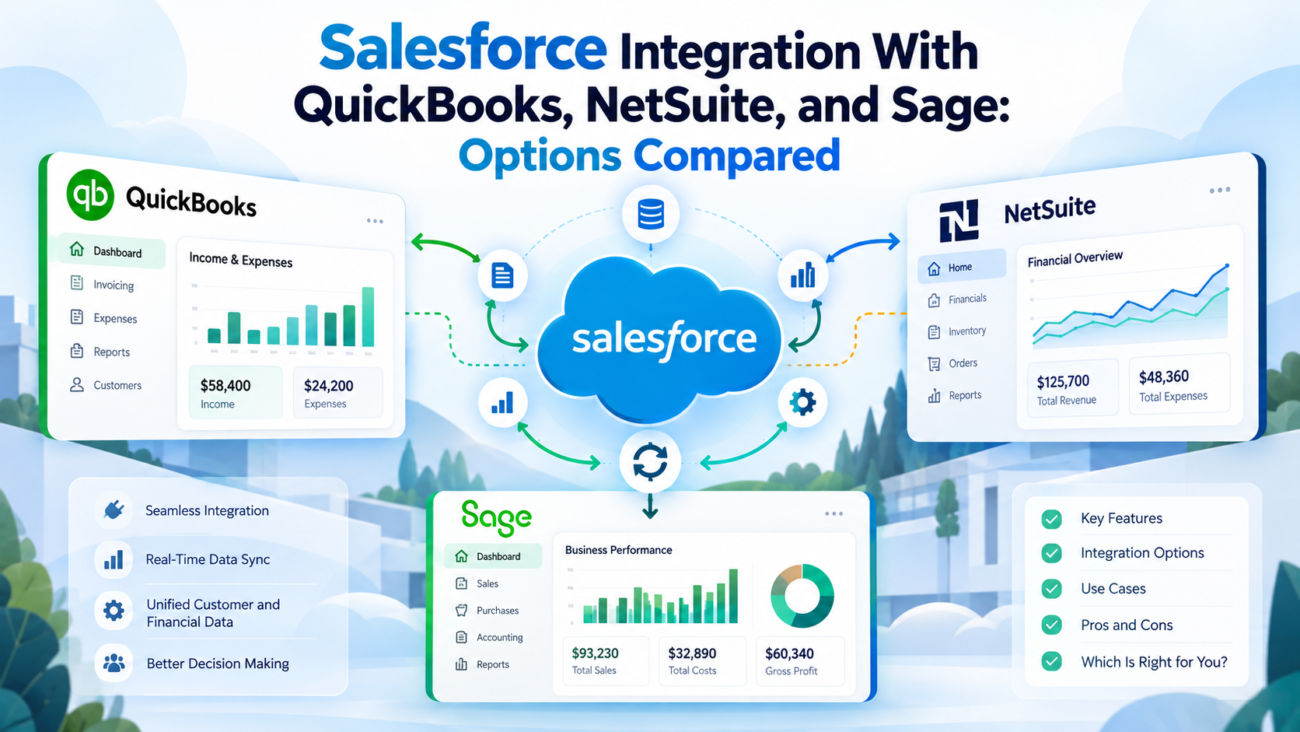
Salesforce holds the customer conversations, deal history, and sales forecasts. Accounting software holds invoices, payments, credits, and the numbers finance closes each month. When those records don’t agree, sales teams chase payment updates while finance teams correct orders that arrived with missing details. If you need hands-on help, HyphenX offers data cleanup for teams in this position.
Salesforce accounting integration gives both teams a shared view of the transactions they need. Yet connecting Salesforce to QuickBooks Online is a different job from connecting it to NetSuite or Sage Intacct. Each product has its own records, permission rules, and ways to exchange data. The right approach depends on which system creates the transaction and what must happen after it changes.
This comparison explains the available integration methods, what each accounting platform can support, and where projects commonly run into trouble. It also covers record ownership, expected costs, and the tests that matter before a live rollout.
TL;DR
Salesforce accounting integration can use a packaged connector, an integration platform, custom API work, or scheduled file transfers. A Salesforce QuickBooks integration often starts with customer, invoice, and payment visibility for a smaller finance team. A Salesforce NetSuite integration usually needs closer control over subsidiaries, items, order status, and accounting rules. A Salesforce Sage integration depends heavily on the Sage product, since Sage Accounting, Sage Intacct, and Sage X3 have different interfaces. Start by naming the record owner and deciding which events should cross systems. Then check API access, field coverage, error handling, and ongoing fees before choosing a tool. A successful Salesforce ERP integration keeps finance in control of posted transactions while giving sales the status it needs.
What Salesforce and Accounting Software Actually Need to Share
Salesforce and accounting software describe some of the same business activity from different angles. An opportunity may show that a customer agreed to buy. It doesn’t prove that an invoice was issued or that money arrived. A paid invoice may close an accounting balance even though the related opportunity was never updated.
The useful connection is built around a few clear questions. Can a rep see whether an account has overdue invoices? Can finance receive an approved order without retyping the customer’s address? Can a sales manager tell booked revenue from collected cash? Each answer needs a defined data source and an agreed update schedule.
Salesforce’s guide to connecting external systems describes several ways to exchange information with outside applications. Those choices matter because looking up an external balance is a different task from creating a financial transaction.
The most common records are customers, products, estimates or quotes, orders, invoices, payments, credits, and balances. Their names may look similar across applications, but their rules often differ. A Salesforce Account can represent an entire corporate group, while an accounting Customer may refer to a specific billed company or location.
This distinction also changes the definition of Salesforce ERP integration. An accounting link may move a few invoice fields. A Salesforce ERP integration can reach into fulfillment, stock levels, subsidiaries, or revenue schedules. A project should describe its actual scope rather than assuming that connecting 2 applications makes every business process available.
The Four Main Ways to Connect Salesforce to an Accounting System
There are 4 practical routes. None wins in every situation. The best choice follows the required records, how often they change, the team’s ability to maintain the connection, and the risk of a failed update.
Packaged Salesforce Connector
A packaged connector is a product built to join a specific accounting system with Salesforce. It may install a managed package, provide a hosted service, or combine both. Common functions include field mapping, a sync schedule, and an error screen. Coverage varies by product and paid plan.
This route suits a defined Salesforce QuickBooks integration where the business needs known objects and has limited technical staff. A connector can also suit Salesforce Sage integration when the vendor explicitly supports the exact Sage product and edition in use. Check the supported transaction types rather than accepting a general claim that it connects the applications.
Integration Platform
An integration platform connects systems through reusable workflows. It can receive an event, transform data, look up related records, and then call the accounting API. It usually offers more control than a narrow connector, especially when orders also touch an online store, warehouse, or billing service.
Salesforce offers External Services actions for calling suitable APIs through Salesforce automation. A broader integration platform may be preferable when a process crosses several applications or needs a durable queue outside Salesforce.
Custom API Integration
A custom service uses the published APIs of Salesforce and the accounting system. Developers choose the exact fields, controls, and rules. This can fit unusual approvals or a complex Salesforce NetSuite integration where a standard connector leaves out important records.
Custom work brings responsibility for authentication, API changes, monitoring, and recovery after failures. Initial development is only part of the cost. Someone must own the service after the original developer leaves.
Scheduled File Exchange
CSV exports, secure file transfers, and controlled imports remain useful for small or low-frequency jobs. A nightly read-only balance update may not need live events. Files are a poor fit when sales expects immediate payment status or when a failed upload could silently create duplicate orders.
Salesforce and QuickBooks Online Integration
QuickBooks Online is often the simplest of the 3 accounting families to scope when the required work is basic customer and invoice visibility. The difficulty rises when both applications can edit the same contact, when many line items need matching, or when estimates are treated as accepted sales orders without a clear rule.
A Salesforce QuickBooks integration commonly sends approved customer details or invoice requests toward accounting and sends invoice status, payment dates, and open balances back. Exact capabilities depend on the connector and the QuickBooks company configuration. Treat each write operation as a separate requirement.
QuickBooks Online Is Not QuickBooks Desktop
The 2 products have different connection methods. QuickBooks Online offers a cloud accounting API and an OAuth authorization flow. A connector described only as supporting QuickBooks may work with Online but not with Desktop. Desktop connections can require a local component, a different SDK, or a file-based process.
For QuickBooks Online, Intuit explains the OAuth 2.0 setup used to approve an app’s access to a company. The authorization is tied to the connected company ID, so teams with several QuickBooks companies need to handle each connection deliberately.
An integration design should say whether it supports Online or Desktop, the exact country edition, and the transactions it can create. Those details are worth settling before the team starts mapping fields.
What Can Move Between Salesforce and QuickBooks?
Customer names and billing addresses usually need careful matching because both systems may contain older versions. Invoices need accounting-side rules for terms, tax, item references, and numbering. Payment data is generally safer as a read-only feed into Salesforce, where it can inform account teams without letting reps change the ledger.
Intuit provides webhook configuration guidance for receiving supported change notifications from QuickBooks Online. A webhook can tell an integration that something changed, but the receiving service still needs to validate the message and retrieve or handle the right record.
A basic Salesforce QuickBooks integration may run on a schedule if finance doesn’t need instant updates. If a payment should release an order or change an account hold, the design needs faster delivery and a tested recovery process. Avoid assuming that every object supports the same event behavior.
Rate Limits and Practical Constraints
API calls aren’t unlimited. Intuit’s published API call limits include request throttles and guidance for handling HTTP 429 responses. A project that updates thousands of items should budget calls for both its initial load and routine changes.
Batching can reduce repeated requests, but each batch still needs per-record error handling. An integration that submits 30 operations should record which ones worked. Otherwise, a retry may recreate records that were already accepted. This becomes especially important during imports from an older CRM.
Salesforce and NetSuite Integration
NetSuite serves businesses whose financial records may involve several subsidiaries, currencies, locations, and processes. That changes the work needed to move a Salesforce opportunity into an accounting document. A customer name alone may not identify the correct legal entity, item, or pricing rule.
A NetSuite connection often starts when a deal is marked ready for fulfillment or billing. The integration must decide whether to create a sales order, another approved transaction, or only a request for finance review. NetSuite remains responsible for the accounting rules that apply to the resulting record.
Oracle’s list of supported REST records includes financial and operational objects such as customers, sales orders, invoices, and inventory items. That list establishes possible API coverage, while enabled features, roles, and account settings determine what a specific implementation can use.
REST Web Services, RESTlets, and Older Integrations
NetSuite REST web services expose supported records through standard API operations. RESTlets are scripts created inside NetSuite and are useful when a custom endpoint must enforce special business logic. Older integrations may use SOAP web services, but new projects should first assess the current REST options.
Authentication needs its own review. Oracle’s OAuth 2.0 documentation describes the authorization method for REST web services. Oracle also states that new token-based authentication integrations will no longer be allowed starting with NetSuite 2027.1, making the authentication choice important for work planned in late 2026.
A Salesforce NetSuite integration shouldn’t copy every Salesforce field just because an API accepts it. NetSuite may calculate totals, determine taxes, or reject a transaction tied to the wrong subsidiary. Let the system that enforces each rule make that decision.
Multi-Entity Orders and Inventory
Consider a US sales team selling to a customer billed through a separate legal subsidiary. The opportunity can carry the expected amount, but NetSuite may need the subsidiary, currency, item, location, and customer relationship to create the order. Missing 1 value can stop the transaction even when the opportunity looks complete.
Inventory also needs a precise definition. Available-to-promise stock is different from physical stock on hand. A sales screen should label what it shows, when it was refreshed, and whether that quantity is safe to promise. A cached figure may help a rep plan a call but shouldn’t be treated as a warehouse reservation.
Concurrency affects heavy workloads. Oracle explains that web service concurrency is governed at the NetSuite account level across relevant requests. A large order import can therefore affect other connections if it consumes the available request capacity.
The strongest reason to choose an involved Salesforce NetSuite integration is the need to respect NetSuite’s deeper transaction rules. It is also the reason these projects require careful testing with finance and operations.
Salesforce and Sage Integration
Sage is a product family, not 1 accounting API. A search for Salesforce Sage integration may refer to Sage Accounting, Sage Intacct, Sage 50, Sage 100, or Sage X3. The first requirement is the complete product name, edition, region, and deployment arrangement. A connector for 1 Sage product cannot be assumed to support another.
Sage Intacct
Sage Intacct is a cloud financial management system. Its interfaces can support customer and finance workflows, but available objects and permissions must be checked against the specific account. Sage’s Intacct developer portal documents a REST API and notes that access requires a Web Services developer subscription.
A Salesforce Sage integration involving Intacct may exchange approved customer records, invoice details, project references, or payment status. Businesses with several entities should confirm how company and location dimensions are represented. The team also needs to verify that the chosen API endpoints cover the required write actions, rather than assuming older XML functions and REST operations are identical.
Sage Accounting
Sage Accounting has a separate cloud API. Sage’s Accounting authentication guide describes OAuth 2.0 and explains how API requests identify the authorized business. This matters when a person can access several businesses from the same Sage user account.
The usual requirements are simpler than a multi-entity ERP project, but country availability and feature differences still matter. Confirm that the required invoice and contact operations exist for the product edition in use.
Sage 50, Sage 100, and Sage X3
These products need separate checks for local hosting, supported interfaces, and connector maintenance. Some deployments require an on-premises bridge or an approved third-party component. Calling the project a cloud-to-cloud integration without checking the actual installation creates an avoidable security and support problem.
Related reading: Salesforce Implementation Checklist: 30 Tasks to Finish Before Go-Live
Related reading: Salesforce Consulting Partner in Texas: Local vs. Remote Firms Compared
Sage X3 has its own platform interfaces. The official Sage X3 API guide covers REST and SOAP options for external access. Its available operations and configuration should be reviewed with the administrator responsible for the X3 environment.
For a Sage connection, the product name is as important as the vendor name. It determines whether a packaged connector is realistic and what a custom service would need to support.
QuickBooks, NetSuite, and Sage Compared Side by Side
The table below compares likely project shape, not a fixed list of features guaranteed by each vendor. Connector capabilities can change across versions, subscriptions, and countries.
| Decision Point | QuickBooks Online | NetSuite | Sage Products |
| Typical starting need | Customer, invoice, payment visibility | Orders, financial entities, operational status | Depends on Sage edition and finance process |
| First technical check | Online vs. Desktop; company access | REST coverage, roles, subsidiaries | Exact product, hosting, supported API |
| Common integration route | Packaged connector or API | Integration platform or custom API | Packaged or custom, depending on product |
| Main data risk | Duplicate contacts or invoices | Wrong entity, item, or posting rule | Mapping to the wrong Sage product model |
| Likely sync design | Small set of approved records | Controlled order and status workflows | Product-specific field and event design |
| Maintenance focus | Token renewal and API throttles | Changes to roles, records, and account capacity | Connector support and edition upgrades |
A small business with 1 QuickBooks Online company may only need a Salesforce QuickBooks integration for overdue balances and issued invoices. A larger business may require a Salesforce NetSuite integration that covers the route from approved order to fulfillment. Sage Intacct may support similarly involved finance processes, while Sage Accounting may call for a narrower link.
Mapping Customers, Products, and Transactions Without Duplicates
A connector can move data correctly and still produce the wrong business result. The most common cause is a bad match between records. Salesforce accounting integration therefore needs a matching policy before the first customer or invoice is copied.
Start with stable IDs. Store the accounting customer ID in Salesforce, and store the Salesforce record ID in the integration’s mapping table or an approved external-reference field. Names and email addresses can change. They aren’t reliable unique keys for every business, especially when several locations share a billing address.
Decide Who Owns Each Field
An account executive may own the commercial contact name and account relationship. Finance may own billing terms, tax treatment, and the legal billing name. Put those rules in a field map that states source, destination, update direction, and what happens when values conflict.
For Salesforce accounting integration, don’t give both applications unrestricted control of the same financial field. If the invoice due date changes in accounting, that value should normally flow to Salesforce for display. A sales user changing the visible date shouldn’t automatically rewrite the posted invoice.
Products pose another matching problem. Salesforce products and price books can describe selling choices, while accounting items have their own identifiers and posting behavior. A bundle sold as 1 commercial package might have several accounting line items. The integration must know whether to break it into components or send an approved item code.
Handle Existing Records Before New Ones
Run a matching exercise before the initial load. Identify accounts with the same legal name, customers with several bill-to locations, products without accounting codes, and invoices that reference inactive customers. Resolve uncertain matches with human review instead of creating a new record for every mismatch.
Salesforce accounting integration also needs a rule for merges and deletions. Merging 2 Salesforce Accounts shouldn’t erase an accounting customer with posted history. Likewise, deleting a CRM contact should not remove a required financial record. A durable cross-reference table lets the systems keep different record lifecycles without losing their relationship.
Designing the Quote-to-Cash Workflow
Quote-to-cash covers the path from a customer accepting an offer to finance collecting and recording payment. Salesforce accounting integration works best when that path is split into clear business events, each with its own approval and failure rule.
A practical sequence begins when the sales team completes a quote or opportunity. An approval step checks customer details and product codes. The integration then creates a request or transaction in the accounting system, stores the resulting ID, and returns the document’s state to Salesforce. After invoicing, finance events can update the balance and payment status shown to sales.
The process should distinguish a sales commitment from an accounting record. Closed Won does not always mean an invoice should be created. Some companies bill only after shipment, service delivery, or a milestone. The trigger must follow the actual finance policy, not the easiest Salesforce field to watch.
Payment Updates and Credit Notes
Payment information is valuable because an account manager can see whether a customer owes money before renewing a contract. The feed should include a timestamp and indicate whether the amount represents an open balance, paid amount, or disputed item. A simple Paid checkbox may hide partial payments and credit applications.
Credits and refunds also need proper handling. A customer may pay an invoice and later receive a credit memo. If Salesforce stores only the last payment event, the account can appear settled when the adjusted balance tells a different story. Read the authoritative financial balance rather than trying to calculate it from scattered CRM events.
Some finance platforms can notify another system when a record changes. Sage documents Intacct outbound webhooks linked to its platform triggers, including retry behavior for certain delivery failures. Those events may support a Salesforce Sage integration, provided the needed trigger and record are available in the customer’s environment.
For Salesforce accounting integration, build the workflow around an explicit status model: submitted, accepted, rejected, invoiced, partially paid, and closed when applicable. The integration should report the actual source state, not invent a universal set of statuses that every accounting system supposedly uses.
Choosing Sync Direction, Timing, and Recovery Rules
Every object needs a direction. A one-way feed may send accounting balances to Salesforce. A two-way flow may exchange customer contact details, but it needs conflict rules. Salesforce accounting integration becomes risky when people assume that bidirectional sync means any field can change anywhere.
Scheduled polling fits balances that can be a few hours old. Events are useful when an approved order needs prompt processing. A hybrid design often makes sense: events carry recent changes while a nightly check compares records and catches anything missed.
Salesforce’s Change Data Capture guide describes event notifications for CRM record changes. A subscriber can respond to those events, but the service still needs to fetch required context, check the accounting rules, and record whether the destination accepted the change.
Prevent Loops and Duplicate Writes
Suppose the integration updates an Account in Salesforce after a customer edit in finance. Salesforce then emits another change. Without a source marker or field-level rule, the update can travel back to finance repeatedly. This wastes requests and may overwrite a newer correction.
Use an idempotency key or equivalent transaction reference so a retry can’t create the same invoice twice. Keep both the source ID and destination ID. Retry temporary failures with controlled delays, but send invalid tax codes or missing customer mappings to a review queue. Repeating a bad request won’t repair its data.
Salesforce accounting integration needs an exception log that a person can understand. Record the source transaction, attempted action, error reason, retry count, and next owner. Give finance a reconciliation report for submitted orders with no accounting ID and issued invoices that never reached Salesforce.
Finally, test what happens when either application is unavailable. A queue should retain approved work, respect event retention limits, and resume safely when the connection returns. An alert without a recovery plan merely tells the team that work is stuck.
Security, Permissions, and API Limits
Financial integrations should use the smallest access level that supports the agreed workflow. Sales users usually need to see payment status, not obtain permission to change posted invoices. Salesforce accounting integration should preserve this separation in the connector, service account, and Salesforce screens.
For outbound calls from Salesforce, named credentials help manage endpoints and authentication outside business logic. They reduce the need to place secrets in custom code, while the associated user permissions still require careful setup.
Check how tokens are renewed and revoked. Determine who can authorize the accounting connection, whether the app runs under a service identity, and how access is removed when an employee leaves. Separate testing and live credentials, and avoid giving developers broad production finance permissions merely to make a proof of concept work.
API limits affect reliability as much as security. The project should estimate daily requests, bursts at month-end, and the number of connected companies. A Salesforce ERP integration that works with 20 test orders may behave differently when several thousand renewals reach the queue in 1 hour.
Sensitive information also needs restraint. Salesforce may need an invoice number, due date, and amount without receiving bank account data or detailed journal entries. Document which fields move, where they are stored, and how long logs retain them. Keep personal information out of error messages when a reference ID will do.
What Salesforce Accounting Integration Costs
There isn’t a single reliable market price for these projects. Costs depend on the accounting edition, number of connected entities, records, custom rules, and support agreement. Published connector prices also change, and some vendors quote separately for extra workflows or transaction volume.
The direct expenses commonly include connector subscription fees, integration-platform charges where used, implementation work, product API or developer access where applicable, and ongoing support. For a custom service, include hosting, logs, security maintenance, and time spent responding to failed jobs.
A Salesforce QuickBooks integration that shows invoices and balances will often require less design work than a multi-subsidiary Salesforce NetSuite integration. That isn’t a promise about a vendor’s quote. Difficult legacy data, tax handling, or custom approval rules can reverse the expected effort.
Treat cost as total work over time, not the first setup invoice. Use the following questions when comparing proposals:
· Which exact accounting product, edition, and companies are included?
· Which objects support reading, creating, and updating?
· Are retries, error alerts, reconciliation, and audit logs included?
· What happens when API usage grows or a vendor changes an endpoint?
· Who pays for bug fixes and connector upgrades after launch?
Salesforce accounting integration proposals should also specify acceptance tests. A low initial price has limited value if finance must manually repair duplicate invoices every week. Budget for monitoring and a clear owner for ongoing exceptions.
A Practical Implementation Plan and Test Checklist
The first step is to write down what success looks like. For example, a sales rep can see an invoice’s current balance within an agreed time, or finance receives every approved order once. Salesforce accounting integration can then be measured against a real outcome instead of the vague goal of keeping systems synchronized.
Start with a small discovery sample: recent customers, 1 straightforward invoice, 1 partial payment, 1 credit, and at least 1 record that should be rejected. Review how those records appear in Salesforce and the chosen accounting system. This exposes mismatched fields early.
Next, choose which system owns each field and confirm the required API permissions. Build the customer cross-reference, define each trigger, and decide whether changes should run by event or schedule. The initial load deserves its own plan because it can expose duplicates that routine updates never would.
Test the Cases That Break Real Integrations
The happy path proves that a connection exists. A release decision needs the difficult cases too. Use these checks in a test environment before approving live financial writes:
· Create an order twice with the same source ID and confirm that accounting receives only 1 transaction.
· Reject a record with an invalid customer or item and confirm that the error names the affected record.
· Apply a partial payment and check that Salesforce shows the remaining balance.
· Change a customer address in the non-owning system and confirm that the approved source retains control.
· Disconnect access, restore it, and confirm that pending work resumes without gaps or duplicates.
· Compare record counts and totals for a defined period, including credits and canceled records.
A Salesforce Sage integration should add an edition-specific test for its supported connector or API. A Salesforce ERP integration involving NetSuite or Sage Intacct should also test entity restrictions, currency settings, and roles. These checks should reflect the actual deployment rather than a generic feature sheet.
After testing, release a narrow set of records first. Watch exception counts and reconcile results with finance. Expand only when the first workflow is stable and the people responsible for fixes know what each error means.
Choosing the Right Connection for Your Finance Process
The right Salesforce accounting integration is the one that moves approved information between clear record owners and can recover when something fails. QuickBooks Online often suits a narrower invoice-and-payment feed. NetSuite can support broader order and financial workflows, but those rules need more design work. Sage decisions must begin with the exact product and deployment.
Related reading: Salesforce Nonprofit Cloud vs. NPSP: Should You Migrate Now
A Salesforce ERP integration should keep transaction authority with the system responsible for financial control. Sales can then see useful status without turning Salesforce into a second ledger. That separation makes the connection easier to explain, test, and maintain as the business changes.
Frequently Asked Questions
Can Salesforce Integrate Directly With QuickBooks Online?
Yes. The applications can exchange data through a suitable connector or a custom integration using supported APIs. The exact objects and write actions depend on the chosen method. A Salesforce QuickBooks integration should first define who creates invoices and how customer records are matched.
Is There a Native Salesforce NetSuite Integration?
There isn’t 1 universal built-in connection that covers every NetSuite process. Teams usually assess packaged integrations, an integration platform, or custom API work. A Salesforce NetSuite integration needs particular care with subsidiaries and financial record permissions.
Which Sage Product Can Connect to Salesforce?
Several Sage products have integration routes, but they don’t share a single interface. A Salesforce Sage integration must identify whether the company uses Sage Accounting, Sage Intacct, Sage 50, Sage 100, or Sage X3 before selecting a connector.
What Is the Best Integration Method for a Small Business?
A maintained packaged connector is often a reasonable first option when it supports the required fields and has useful error reporting. Compare its coverage with the actual workflow and total ongoing cost. A simple scheduled import may be enough for read-only monthly reporting.
Should Invoices Be Created in Salesforce or Accounting Software?
Finance should approve the system that creates the official invoice. Salesforce can send a request with approved customer and order details, while the accounting application applies its own tax and posting rules. Keep the accounting invoice ID linked back to Salesforce.
Can Salesforce Show Unpaid Invoices and Balances?
Yes, if the selected accounting API or connector exposes those records. Display the amount, status, and last update time so reps know whether the balance is current. This is often a useful first phase for Salesforce accounting integration.
Does Integration Require Real-Time Sync?
No. Real-time or near-real-time delivery is useful for urgent order processing. Scheduled updates are often sufficient for balances or reporting. Pick the timing from the business consequence of stale information, not from the connector’s marketing claims.
Can Salesforce and QuickBooks Sync Payments Both Ways?
Some products support payment-related operations, but an unrestricted two-way payment sync is rarely necessary. Accounting should usually own the posted payment. Salesforce can receive payment status and remaining balance without becoming another payment ledger.
How Does NetSuite Handle Multiple Subsidiaries?
NetSuite uses entity and transaction rules that can depend on subsidiary configuration. The integration must send valid customer, item, currency, and subsidiary references for each operation. Test each relevant legal entity rather than assuming 1 successful order covers them all.
Can Sage Intacct Send Updates to Salesforce?
Sage Intacct has APIs and event options that may support outbound updates. A Salesforce Sage integration still needs the correct permissions, mapped records, and a receiving service. Confirm whether the specific transaction changes can trigger the required event.
Is Custom API Work Better Than a Connector?
Custom code can handle unusual rules, but it requires long-term ownership. A connector may be better for common workflows when it covers the necessary objects and recovery features. Compare missing functions and maintenance needs before choosing.
How Do You Prevent Duplicate Customers and Invoices?
Use stable record IDs, a cross-reference map, and duplicate-safe retry logic. Don’t match every customer by name alone. Test repeated events and interrupted requests before allowing an integration to create live financial documents.
How Long Does a Salesforce ERP Integration Take?
The schedule depends on object count, data quality, approval rules, and test coverage. A read-only balance feed has far less work than a multi-entity order flow. Build a timeline from verified requirements rather than relying on a single promised duration.
What Happens When an Accounting API Is Unavailable?
A dependable connection records the failed operation, retains work that can safely be retried, and alerts the assigned owner. It also checks for successful transactions before sending a request again. Some errors need human correction instead of another retry.
How Can Teams Confirm That the Integration Works?
Compare approved source records with accepted destination records for the same period. Check amounts and status changes, including partial payments and credits. Monitor missing IDs, failed jobs, and unexplained differences after launch.
