
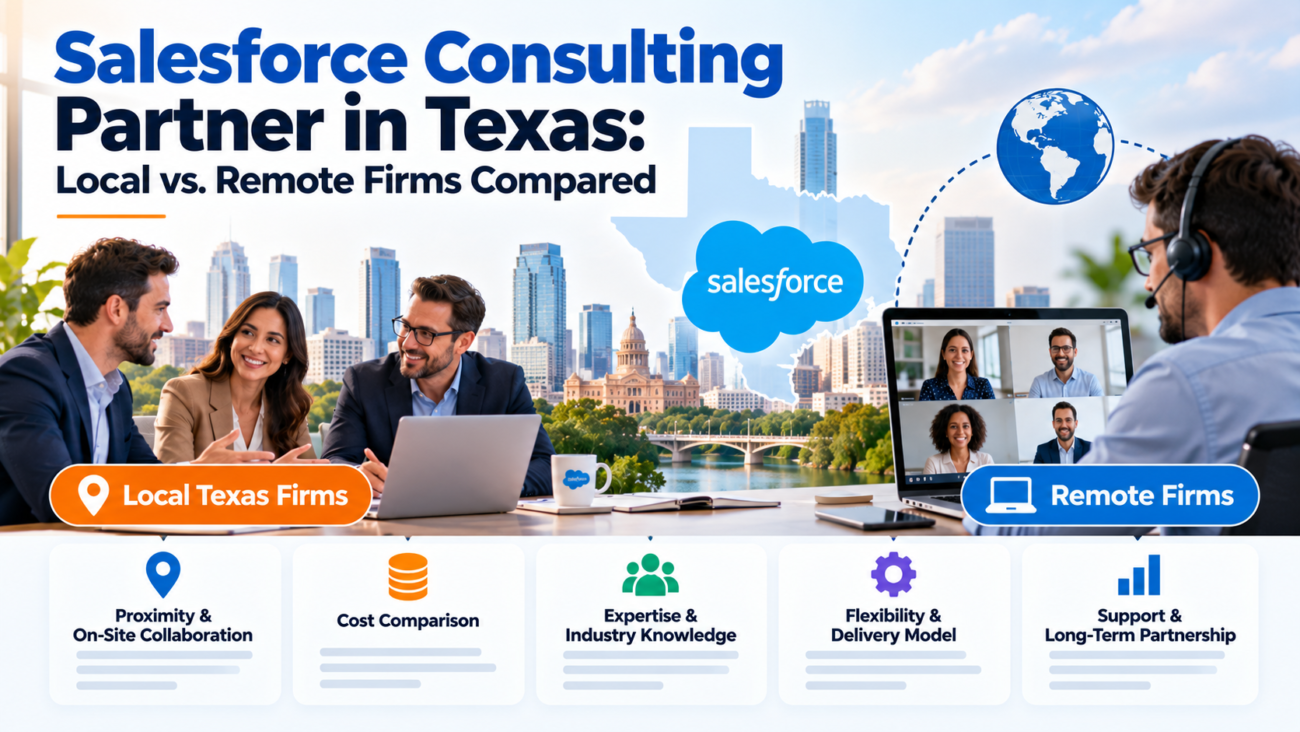
Texas companies need to compare local access with specialist experience when choosing a Salesforce consulting partner in Texas. A nearby team can observe work on-site and settle decisions with the people who use the system. A remote firm may bring stronger experience with the exact Salesforce products or integrations involved. The best fit depends on the work required and the people assigned to deliver it.
A nearby consultant can observe work and hold workshops without arranging a flight. A remote firm may have the exact product or industry experience a project needs, even if none of its specialists live in Texas. Both can deliver strong work. Both can also fail when the contract hides who will do the work or leaves testing and support to the customer.
The choice affects project cost, delivery speed, communication, and ownership after launch. Office location is only one part of that decision. This guide compares local, remote, and hybrid engagement models; explains how to verify expertise; and sets out the questions Texas businesses should settle before choosing a partner.
TL;DR
Choose a local Salesforce firm when site visits, live process observation, and in-person decisions have clear value. Choose a remote firm when the work depends on specialist skills, the internal team can collaborate online, and the proposed consultants have proved their experience. A hybrid team can combine local discovery with remote delivery. Compare the named people, project scope, security plan, total fees, and handover terms using one scorecard. A Salesforce consulting partner in Texas should earn the contract through relevant work and accountable delivery, rather than a Texas address alone.
What Local and Remote Salesforce Firms Actually Mean
A local Salesforce consultancy normally maintains an office or working team within Texas and can send staff to the customer’s site. That label doesn’t guarantee the assigned architect lives nearby. A firm may sell a project through its Dallas office while using consultants in other states or countries. The proposal needs to state who will attend workshops and who will build the solution.
Remote Salesforce implementation means most discovery, configuration, development, testing, and support take place through online meetings and shared project systems. The team may be elsewhere in the United States or across several time zones. Remote work can include occasional site visits, and a Texas-headquartered firm can still deliver almost every task remotely.
A Practical Comparison
| Decision Factor | Local Delivery | Remote Delivery |
| Workshops | Easier to arrange on-site sessions | Usually held online |
| Specialist access | Depends on the local team and wider practice | Potentially wider hiring pool |
| Travel expenses | May be lower for Texas site visits | May arise when visits are requested |
| Time-zone overlap | Often straightforward | Must be checked for named staff |
| Process observation | Convenient for physical operations | Needs video, documents, or planned visits |
| Oversight | Can include in-person reviews | Requires reliable online reporting |
| Cost certainty | Depends on scope and staffing | Depends on scope and staffing |
| After-launch support | Can include local visits | Commonly delivered through remote channels |
A comparison of Texas Salesforce consulting firms should therefore identify the actual project team, not classify companies by the address on a website. Ask for the proposed on-site calendar, expected travel charges, and tasks that require presence.
What a Consulting Partner Should Be Responsible For
A Salesforce consulting partner in Texas should translate business requirements into a working system and leave the customer able to operate it. That means more than creating fields or dashboards. The firm must understand current processes, explain design choices, test what it builds, and document what changes after launch.
The exact services depend on the project. A small Sales Cloud rollout may need lead stages, account rules, permissions, reporting, and training. A multi-department program may also require custom code, API connections, historical data, and a staged release. The customer’s own team retains responsibility for business decisions and approving access.
When screening a consulting firm, the official partner directory is a useful starting point. Salesforce’s Partner Finder lets buyers review areas of expertise, project experience, and credentials. Those details support initial screening, but they don’t establish that the people assigned to your project have completed comparable work.
Separate Advice From Delivery
Consulting includes deciding what should change and which requirements should stay out of scope. Delivery includes configuration, integration, migration, test fixes, and release activities. A company may be strong at one and weaker at the other. Ask which consultants will own process design and who has authority to settle technical decisions.
Look for named deliverables rather than a vague promise of business improvement. Useful outputs include an approved requirements record, architecture decisions, field mappings, test cases, release checklist, administrator documentation, and a support transition plan. The customer should be able to inspect these items during the project.
A Salesforce consulting partner in Texas should also explain how it will gather reliable evidence about day-to-day workflows without continuous site access. Screen-sharing and recorded walkthroughs help, but the people who actually use Salesforce must review the findings. A diagram approved only by managers may overlook exceptions handled by front-line staff.
Why Geography Matters Differently Across Projects
Geography affects collaboration most when the team must observe physical operations or coordinate people who rarely work at desks. A Texas manufacturing company may use Salesforce alongside warehouse systems and service dispatch. Watching staff handle inventory exceptions can reveal problems that won’t appear in an online requirements form.
By contrast, a digital sales organization may already run its pipeline reviews and customer meetings online. Its users can demonstrate their current CRM problems over a shared screen. Remote delivery may then have little practical disadvantage, especially when specialists overlap with the business’s working hours.
A Salesforce consulting partner in Texas becomes more valuable through proximity when key executives need rapid in-person workshops or several facilities need coordinated change. The partner must still reserve time for those visits. A local address won’t shorten a queue if its senior architect is booked on another engagement.
Decide Which Meetings Need a Room
Start by listing the decisions that depend on observing work or bringing groups together. Examples include service dispatch handoffs, shop-floor data capture, and regional sales meetings where teams disagree about account ownership. Define a tangible result for each proposed visit: an approved process map, a resolved exception list, or signed-off test evidence.
Local Salesforce consultants should be judged by how effectively they use on-site time. A visit spent watching slides delivers little additional value. A focused session that resolves unresolved process steps may prevent several weeks of rework.
Texas Business Conditions That Change Partner Fit
Texas has several major business centers, but they don’t all create the same CRM requirements. Houston organizations may need project-based sales, energy-related service activity, or complex account structures. Dallas-Fort Worth businesses may run multi-location sales or distribution operations. Austin firms may focus on subscription sales and product-led customer management. San Antonio organizations can have large service teams or regulated customer records.
These are possible workloads rather than rules about each city. Industry, transaction volume, and internal systems matter far more than the city itself. A Salesforce consulting partner in Texas should understand the specific workflow behind the request and show relevant work completed by its proposed delivery staff.
Multi-Site Operations Change Discovery
A firm with teams in Houston and Dallas may need separate workshops even if its consultant sits in Austin. One region may use different account ownership rules or service codes. Another may have local spreadsheets that never reach the CRM. A single headquarters session can miss those differences.
When comparing Texas Salesforce consulting firms, ask bidders how they would sample users across locations and confirm common requirements. They should identify processes that must be consistent statewide and exceptions that the system must support. A local firm with travel capacity can help, while a remote firm can use recorded demonstrations and selected site visits if the plan is clear.
Industry Experience Outweighs the ZIP Code
A company handling complex field service work should value a partner that understands service appointments, inventory dependencies, and mobile user adoption. A software company that sells through a channel needs help with lead routing, partner access, and recurring revenue records. Local Salesforce consultants without those skills may require more discovery and corrections than a remote specialist.
How to Verify Credentials and Relevant Experience
Start with the firm’s Salesforce partner status, but continue to the people it plans to assign. Salesforce certification identifies knowledge assessed through a credential. It doesn’t prove that a person has led the same kind of migration or solved the same integration failure your team faces.
Project fit depends on the work, not the firm’s reputation alone. Salesforce’s partner assessment guidance recommends reviewing complexity, customer resources, proposals, and evidence of work. The same provider may suit a standard rollout but struggle with a highly customized legacy system.
Request the names, roles, relevant certifications, project allocations, and time commitments of the core team. Confirm which work will be subcontracted. Use Salesforce’s credential verification to check certifications for the named people, allowing for updates to the public records. The senior person featured in sales meetings may otherwise disappear once delivery begins.
What to Ask a Reference
A reference call should focus on what happened during difficult moments. Ask whether the partner named risks early, whether promised staff stayed involved, and how changes to scope were priced. Find out whether the customer could maintain the system after handover. A glowing comment about good communication isn’t a substitute for those facts.
Public profiles help form a shortlist before interviews begin. The AppExchange consulting listings allow filtering consultants by location and reported expertise. Treat reviews as supporting evidence, and verify current staff and recent projects because profiles can lag behind team changes.
For Texas Salesforce consulting firms, check whether the local team is made up of employees, occasional travelers, or partner subcontractors. The arrangement isn’t inherently wrong, but you need to know who can attend a critical workshop and who is accountable for a production incident.
Ask for a Short Technical Walkthrough
Give shortlisted firms the same anonymized scenario. For example, a sales opportunity must be sent to a separate billing platform after approval, but the billing platform can reject the request. Ask how each firm would handle the error, alert the business, and prevent duplicate records.
The best response should explain choices and tradeoffs in plain terms. It should also identify unanswered questions. A firm that promises every integration will be easy before reviewing the other system’s API hasn’t supplied a dependable estimate.
Project Scope and Technical Work That Affect Delivery
A Salesforce consulting partner in Texas should define the work in business terms before estimating technical effort. “Improve pipeline reporting” is too vague. “Show open opportunities by assigned region using a consistent close-date policy” can be reviewed and tested. That level of detail limits disputes about what was promised.
Migration Has Its Own Workstream
Moving customer data involves mapping source fields, standardizing values, preserving relationships, and deciding which old records belong in the new system. Loading files is only the last part of the work. A clean test import should happen before a final cutover.
Migration estimates need a clear data preparation plan. Salesforce’s migration best practices call for defining scope, preparing object templates, and checking relationships. When reviewing Texas Salesforce consulting firms, a proposal with very few hours for complex historical data should explain who will cleanse it and approve the result.
Ask the bidder to show record-count assumptions, duplicate rules, archival choices, and reconciliation tests. If a Salesforce consulting partner in Texas excludes data cleanup, put that exclusion beside the price so other bids can be compared on the same basis.
Related reading: Service Cloud Implementation Cost and Timeline for Contact Centers
Integrations Require Failure Handling
A remote Salesforce implementation often exchanges data with ERP, billing, service, identity, or reporting systems. Each connection has questions about ownership, authentication, updates, and recovery after a failed request. A partner should define which system is authoritative for each field and how conflicts are resolved.
Consultants should explain the choices behind proposed connections. Salesforce’s integration patterns describe approaches for data exchange and coordination. The choice depends on timing, failure behavior, and the systems involved. Ask why the method fits the workload rather than accepting an API diagram without operating rules.
Comparing Fees Without Inventing a Market Rate
Pricing depends on the approved scope, technical complexity, delivery roles, and contract terms. An office in Texas doesn’t create a fixed premium, and a remote firm isn’t automatically cheaper. Published hourly ranges often mix senior architects with junior administrators or exclude migration and testing. They can’t establish the actual price of a specific project.
Instead, compare bids through a shared cost structure. Require each provider to estimate discovery, configuration, custom development, data work, integration, testing, training, deployment, and post-launch support separately. List the customer’s own staffing commitments as well. An inexpensive proposal can become costly if it assumes the buyer will handle most data cleansing or user testing.
Read the Rate Card Alongside the Work Plan
| Cost Item | Question for the Bidder | Common Omission |
| Discovery | Which workshops and outputs are included? | Extra interviews after kickoff |
| Configuration | Which objects and flows are in scope? | Revisions after acceptance |
| Development | Who builds and reviews custom code? | Technical debt cleanup |
| Migration | Who cleans and reconciles records? | Manual source correction |
| Integration | Which endpoints and test cases are covered? | Third-party API work |
| Training | Which user groups receive training? | Materials for later hires |
| Travel | Are visits and expenses included? | Unplanned on-site days |
| Support | What period and response terms apply? | Fixes after warranty |
A hypothetical comparison shows why totals need context. Firm A proposes a $90,000 fixed-price delivery with specified workshops and a defined migration. Firm B proposes $70,000 but excludes source cleanup, training, and travel. Those figures are examples for evaluating contract scope, not current market quotes. The second bid can’t be called cheaper until excluded work is priced.
A local consulting proposal should state which visits are included and what triggers extra travel charges. A Salesforce consulting partner in Texas should explain when on-site work becomes necessary and who approves that cost. Avoid accepting a fixed price that excludes decisions the project can’t complete without.
Fixed Price Versus Time and Materials
Fixed price can fit a well-defined rollout with stable requirements and clear acceptance tests. It needs an agreed process for changes. Otherwise, small clarifications can trigger repeated change requests.
Time and materials can suit uncertain discovery or phased technical work. The buyer needs a budget ceiling, regular burn reports, and named approval authority. Neither model replaces clear requirements. The right choice depends on how much can be known before delivery begins.
How Communication and Governance Should Work
Communication quality matters more than meeting frequency. A good project rhythm separates decisions, progress reporting, and problem resolution. The customer should always know which requirements are approved, what is blocked, and who must act next.
For a Salesforce consulting partner in Texas, face-to-face access may shorten some decisions, but an on-site meeting shouldn’t become the only place choices are recorded. Every project needs a shared decision log and a record of what was accepted. Staff changes or later disputes are much harder to manage when agreements live only in conversations.
Define the Working Cadence
Agree on a weekly delivery review, a visible task board, a separate channel for urgent blockers, and a routine for sign-offs. Each review should include evidence of completed work, not an unsupported percentage.
For remote Salesforce implementation, insist on overlap hours for the actual delivery team. Identify which work may happen asynchronously and when questions will receive answers. A team several hours away can work well if decisions arrive during the customer’s business day. A team that regularly waits overnight for basic answers may lose time.
Texas Salesforce consulting firms with mixed local and offshore staff should identify their handoff process. Ask who receives an issue after the local lead finishes the day and who can approve a correction. A handoff plan is especially important during migration rehearsals and launch weekends.
Keep Business Ownership Visible
A product owner from the customer should approve process choices. Department leads should supply real examples and test the results. The implementation partner can advise and execute, but it shouldn’t decide sales compensation rules or customer access policy without business approval.
Security, Privacy, and Vendor Access in Texas
Texas businesses need to assess what customer or employee information a consulting firm will access. The risks depend on the data and the systems involved rather than whether a consultant works in Austin or another state. Remote access can be controlled effectively. Local staff can also make mistakes when given broad permissions.
Plan access before moving any live records. Salesforce explains its data access model through object permissions, field permissions, and record sharing. A partner should document who can change sensitive information. Temporary project accounts shouldn’t receive unrestricted access merely because setup is easier.
Apply Texas Privacy Requirements Where Relevant
The Texas Data Privacy and Security Act took effect on July 1, 2024. The Texas Attorney General’s privacy law overview describes applicable consumer rights and business duties, along with exemptions. Whether a particular company falls under the law requires its own legal assessment. The law isn’t a blanket rule covering all CRM records in every Texas organization.
A firm proposing Salesforce data processing should ask how the customer classifies personal data, handles deletion requests, and controls access. Cross-border delivery may introduce additional contractual or legal questions. A Texas office doesn’t prove that every project worker or service provider is based in the United States.
Put Vendor Controls in the Agreement
Require named access approval, multifactor authentication, secure transfer methods, incident notification terms, and a clear process for removing accounts at the end of work. Test access with the intended permission level before the team imports live records. The NIST supplier guide gives buyers a framework for examining technology provider risks before purchase. Never use production exports casually in demonstrations.
Vendor contracts must explain each party’s security duties. The Federal Trade Commission’s vendor security advice recommends recording those duties and checking provider compliance. This applies to local and remote teams. The agreement should state how project data may be used, stored, and deleted.
A Salesforce partner selection process should include the security team before credentials are issued. A signed nondisclosure agreement is useful, but it doesn’t replace limited access or evidence of safe operational practices.
Building a Fair Partner Selection Scorecard
For Salesforce partner selection, choose firms with one documented method rather than relying on the strongest sales presentation. The evaluation should reflect what would cause the project to succeed or fail. A small customer-support setup needs different experience from an ERP integration that affects invoicing.
A consistent evaluation method is more useful than a polished sales presentation. Salesforce offers an implementation assessment tool based on project needs and proposal reviews. Buyers can score the same criteria across every bidder and record why each score was awarded.
Example Weighted Scorecard
| Criterion | Illustrative Weight | Evidence to Request |
| Relevant project delivery | 25% | Comparable work and reference discussion |
| Proposed team capability | 20% | Named staff and verified experience |
| Solution approach | 15% | Architecture and test explanation |
| Project governance | 15% | Decisions, status reports, escalation |
| Full commercial scope | 15% | Included work and stated exclusions |
| Location and site access | 10% | Visit plan and committed availability |
These weights are an example, not an industry standard. Increase location weight when site observation is essential. Increase technical weight when the project depends on custom integration. Rate each firm against the same definition of an acceptable response.
The Salesforce partner selection process should also set mandatory conditions. For example, a provider that cannot satisfy required security controls shouldn’t advance merely because it scores well on price.
Test Claims With One Scenario
Give every shortlisted firm a short written example of the hardest workflow. Ask for a proposed approach, key assumptions, and risk areas. Judge the reasoning rather than demanding a free finished design. This reveals whether the consultants understand the problem and can explain it to the people who will own the system.
Texas Salesforce consulting firms may offer different strengths within a single city. Comparing them with remote firms on identical evidence prevents geography from becoming a substitute for due diligence.
Contract Terms That Matter After the Sale
A statement of work should define measurable deliverables, acceptance rules, responsibilities, dependencies, and how changes are approved. Without these items, “implementation complete” can mean different things to the buyer and the consulting firm.
Specify the environment being changed, planned releases, integrations, and data volumes assumed in the estimate. Include the training audience and test responsibilities. Describe what happens if the customer delays a key decision or the partner changes its assigned architect. The document should distinguish defects in agreed work from newly requested features.
Protect Continuity and Ownership
The customer should receive configuration notes, field mappings, integration documentation, test results, and access to the relevant code repository where applicable. The agreement should address ownership of custom work and any third-party components according to the parties’ legal terms. The buyer needs sufficient documentation to maintain the system or change providers later.
Production releases need a documented plan. Salesforce’s deployment planning guidance advises reviewing dependencies and testing changes before release. Contract deliverables should include a deployment plan, rollback or recovery approach, and sign-off. These safeguards matter regardless of team location.
Define a defect correction period and post-launch support arrangements. Make sure the provider explains which problems it will fix within the agreed fee and how it bills for later improvements. Local Salesforce consultants may offer on-site support, but its availability and price should appear in writing.
An exit clause needs practical detail: account removal, return or deletion of customer data, transfer of open issues, and delivery of project assets. A low initial quote can become a costly dependency when those terms are missing.
Managing the Implementation From Kickoff to Handover
Working with a Salesforce consulting partner in Texas benefits from staged approval because it lets the business test important assumptions before all the work is complete. The exact calendar will depend on scope and available customer staff. Avoid treating a generic number of weeks as a guaranteed Salesforce implementation timeline.
A Salesforce consulting partner in Texas should show a work plan with dependencies and decision points. A useful sequence begins with discovery and design, moves through configuration and data rehearsals, and ends with user testing, release, and support transition. Some workstreams can run at the same time, but dependent tasks need clear owners.
Discovery and Design
Capture the current process using examples of real records and exceptions. Set the future process, the required reports, and the approval rules. Review integrations and data cleanup before confirming scope. The customer should sign off on the design assumptions that affect price or schedule.
A local team might use an on-site workshop here. A remote team might conduct several shorter sessions with users from different locations. The output should be the same: decisions and requirements that can be tested.
Build and Data Rehearsal
Set up Salesforce in a suitable development or test environment. Configure permissions and workflows, then demonstrate working pieces to users. Rehearse data import using representative source records, including difficult relationships and duplicate examples. Record defects early enough to correct them without rushing the release.
Changes should pass through testing before staff use them. Salesforce’s deployment best practices warn against untested changes in production. The delivery plan should explain how code and configuration move through testing and approval. This applies to remote Salesforce implementation and on-site programs.
Acceptance and Cutover
User acceptance testing should use scenarios that reflect actual work, including failed transactions and users with restricted access. Decide which defects must be fixed before launch and which can be scheduled later. Confirm the final migration window, business communications, and support ownership.
Transition to the Internal Team
The project isn’t ready to close while basic administration relies on undocumented consultant knowledge. Internal owners need system diagrams, permission rules, release procedures, and training materials. Establish a backlog for later improvements and a clear route for urgent defects. Salesforce’s administration guidance explains the ongoing role of CRM administration, which continues after the consultants leave.
Final Verdict: Choose Delivery Fit Over Distance
A local firm can be the right choice when the project needs repeated site visits or close coordination with Texas-based operating teams. A remote team may suit a technically difficult implementation where specialist knowledge and disciplined online work matter more than office proximity. A hybrid model can allocate on-site time to discovery and acceptance while reserving remote time for build and testing.
The best Salesforce consulting partner in Texas for a given project is the firm whose assigned people understand the work, identify its risks, and provide a contract that defines what success looks like. Compare verified experience and the full cost of delivery. Test how the team makes decisions and deals with errors. Keep control of data, access, and documentation throughout the engagement.
Location should have a weight in the decision, but only the weight justified by the work. A documented Salesforce partner selection process makes that judgment easier to explain and defend.
Frequently Asked Questions
Is a Local Salesforce Firm Better Than a Remote Firm?
A local firm may be more convenient for site visits and in-person process reviews. A remote firm may offer stronger experience in a particular Salesforce product or integration. Compare their assigned people, scope, and communication plan against your project needs.
How Can I Find a Salesforce Consulting Partner in Texas?
Start with Salesforce’s partner directory and filter for relevant expertise and location. Confirm the firm’s current operating presence and ask which consultants will deliver the work. Review comparable projects and speak with references before making a decision.
Related reading: Salesforce for Higher Education: Recruitment, Advising, and Alumni
Does Salesforce Partner Status Guarantee Project Quality?
No. In Salesforce partner selection, status and credentials provide useful screening information, but they don’t guarantee the outcome of a specific engagement. Assess the experience of the named consultants and review the delivery plan. Ask how the firm handled problems on comparable projects.
Are Remote Salesforce Consultants Usually Cheaper?
There is no reliable rule that remote Salesforce implementation costs less. Rates depend on skill level and scope, while travel and staffing can affect the total. Compare offers from Texas Salesforce consulting firms and remote providers that include testing, data work, training, and support rather than headline hourly prices.
When Is an On-Site Salesforce Workshop Worth Paying For?
An on-site session with local Salesforce consultants is useful when they need to observe physical work, meet several teams, or resolve process disagreements quickly. Define the decisions and outputs expected from the visit. Routine build tasks may not require the same travel.
Can a Texas Firm Use Consultants Based Outside Texas?
Yes. A company may have a Texas office while assigning staff from elsewhere. This is common enough to check when comparing Texas Salesforce consulting firms. Ask for the names and locations of the actual team. For local Salesforce consultants, the agreement should state the expected site visits and how work is handed between time zones.
What Salesforce Certifications Should I Check?
Look for credentials relevant to the products and work in scope, then confirm current status with the proposed staff. A remote Salesforce implementation involving custom integrations needs different experience from a basic Sales Cloud rollout. Certifications should support, rather than replace, evidence from completed work.
How Do I Compare Salesforce Consulting Proposals Fairly?
For Salesforce partner selection, give every bidder the same requirements and request a common breakdown of tasks, roles, exclusions, and fees. Use a weighted Salesforce partner selection scorecard reflecting project risk. Clarify missing assumptions before treating the prices as comparable.
What Should a Salesforce Statement of Work Include?
For local Salesforce consultants and remote teams alike, it should identify deliverables, assumptions, roles, milestones, acceptance tests, and change control. It should also cover data migration, support, security, and handover responsibilities where relevant. Clear terms reduce disputes when requirements change.
Can a Remote Partner Manage a Complex Salesforce Integration?
Yes. A remote Salesforce implementation can work if its team has the needed technical skills and access to system owners. The partner must explain error handling, authentication, data ownership, and test coverage. Remote delivery still requires a dependable response plan during deployment.
How Should My Company Protect CRM Data During Implementation?
Limit project accounts to necessary access, require approved authentication methods, and control data exports. Put vendor security and incident terms in the contract. Test access restrictions before using sensitive production records.
Does the Texas Data Privacy and Security Act Affect Salesforce Projects?
It may affect companies and processing activities within the law’s scope. Applicability depends on the organization and relevant exemptions. Legal and privacy teams should review personal data handling, rights requests, and vendor responsibilities before implementation.
What Is a Reasonable Salesforce Implementation Timeline?
The timeline depends on the scope, data condition, integrations, and speed of customer approvals. A simple rollout may require far less work than a multi-system program. Evaluate the proposed schedule through tasks and dependencies rather than an unsupported universal estimate.
Who Should Own Salesforce After the Consultants Leave?
The customer should designate an internal product owner and an administrator or support arrangement suited to the system. The partner should provide documentation and training before handover. The same obligation applies to local Salesforce consultants and remote providers. Ownership of decisions and access must remain clear even if future support is outsourced.
Is a Hybrid Local and Remote Team a Good Compromise?
A hybrid remote Salesforce implementation works when some decisions benefit from site visits and most technical tasks can run remotely. It should specify which people travel and when. Success still depends on relevant skills, clear approval rules, and shared project records.

2 thoughts on “Salesforce Consulting Partner in Texas: Local vs. Remote Firms Compared”